

Many couples in India choose a court marriage because it is simple, low cost and legal for everyone. It works for couples of the same religion and for couples of different religions or castes. It also works when one partner is a foreign national. There is no pandit, no maulvi, no priest and no big function needed.
But the court marriage process in India confuses many people. Some think they have to go to a court and face a judge. Some think it can be done in one day. Some think they must wait for family consent. None of these is fully true. In this guide, we explain the court marriage procedure in plain words. You will find who can marry, the eligibility rules, the step-by-step process, the document list, fees, time, and common mistakes.
We also cover topics that most blogs miss like the secrecy around the 30-day notice, the Supreme Court’s warning about marriage certificates in 2024, the difference between a court marriage and a simple registration and what to do if you were married in a temple or at home before.
This blog gives general information, not legal advice. Rules on forms, fees and timings differ by state and by district, so check with your local Marriage Officer’s office before you go.
TL;DR (Quick Summary)
- A court marriage is a marriage done under the Special Marriage Act, 1954. It is a civil wedding. It needs no religious ritual, and the couple need not change religion.
- Minimum age: 21 years for the groom and 18 years for the bride. A bill to raise the bride’s age to 21 lapsed in 2024, so the Special Marriage Act has not changed on this.
- The basic steps: file a notice with the Marriage Officer, wait 30 days, then appear with three witnesses and sign. The certificate is usually issued on the day of the wedding or very soon after.
- Minimum time is about 30 days from the date you file the notice. If someone objects, it can take longer.
- Government fees are small in most states, often a few hundred rupees, but they differ by state. Lawyer and paper costs are extra.
- You can also register a marriage that already took place earlier under Section 15 of the same Act.
- A court marriage certificate is strong proof of marriage for passport, visa, bank, insurance and name change.
What Is a Court Marriage?
A court marriage is not a marriage done in front of a judge. It is a marriage solemnised before a government officer called the Marriage Officer, under the Special Marriage Act, 1954. In most places, this officer is the Sub-Registrar, the Sub-Divisional Magistrate (SDM) or the Additional District Magistrate (ADM). The name differs by state.
The Special Marriage Act applies to all Indians, whatever their religion or caste. It also works for Indians who live abroad in some cases. It lets two adults marry without any religious ceremony. After the wedding, the Marriage Officer enters the marriage in a Marriage Certificate Book and gives the couple a certificate.
The Two Types of Court Marriage
People often ask for the two types of court marriage. They are:
| Type | Meaning | Main law section | Who uses it |
|---|---|---|---|
| Fresh court marriage | The couple gives notice, waits 30 days, then marries before the Marriage Officer | Sections 5 to 13 | Couples who have not married yet |
| Registration of an earlier marriage | A couple who already married by some ceremony registers that marriage under the Special Marriage Act | Section 15 | Couples married in a temple, mosque, church, gurudwara or at home |
A third option is not a court marriage but is often confused with it. Hindu, Sikh, Jain and Buddhist couples who have had a valid wedding ceremony can register the marriage under Section 8 of the Hindu Marriage Act. The process is usually faster, but the marriage must have been properly performed first.
Who Can Marry Under the Special Marriage Act? (Court Marriage Rules)
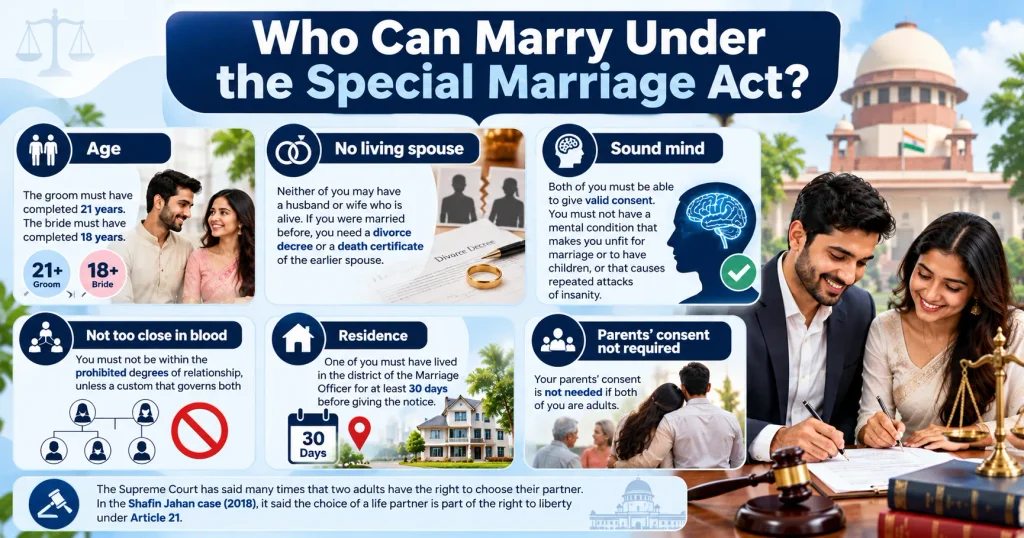
Section 4 of the Act lists the conditions. Both of you must meet all of them.
- Age: The groom must have completed 21 years. The bride must have completed 18 years.
- No living spouse: Neither of you may have a husband or wife who is alive. If you were married before, you need a divorce decree or a death certificate of the earlier spouse.
- Sound mind: Both of you must be able to give valid consent. You must not have a mental condition that makes you unfit for marriage or to have children, or that causes repeated attacks of insanity.
- Not too close in blood: You must not be within the prohibited degrees of relationship, unless a custom that governs both of you allows such a marriage.
- Residence: One of you must have lived in the district of the Marriage Officer for at least 30 days before giving the notice.
Your parents’ consent is not needed if both of you are adults. The Supreme Court has said many times that two adults have the right to choose their partner. In the Shafin Jahan case (2018), it said the choice of a life partner is part of the right to liberty under Article 21.
Court Marriage Age: Has It Changed in 2026?
No. The minimum age is still 21 for men and 18 for women. A Bill to raise the women’s age to 21 was introduced in Parliament in December 2021 and was sent to a standing committee. It lapsed when the 17th Lok Sabha ended in 2024. So, as of now, the Act has not changed. Please check the latest text on India Code before you apply, in case Parliament brings a new bill.
What About Same-Sex Couples?
In October 2023, in Supriyo Chakraborty v. Union of India, the Supreme Court declined to read the Special Marriage Act to include same-sex marriage. At present, a court marriage under this Act is for a man and a woman.
Step-by-Step Court Marriage Procedure in India
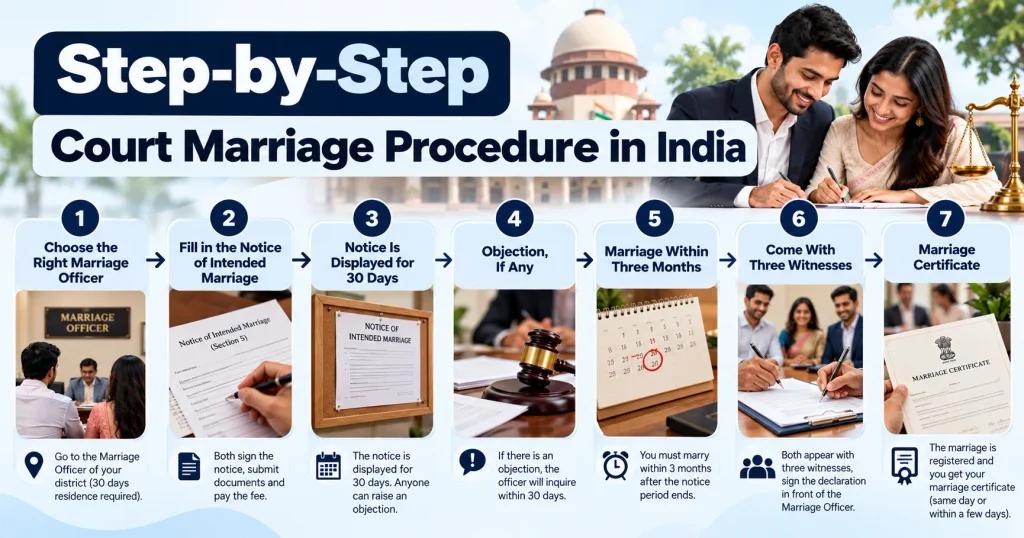
The steps are the same across India, because the Act is a central law. Only forms, fees and timings differ by state.
Step 1: Choose the Right Marriage Officer
Go to the Marriage Officer of the district where at least one of you has lived for the last 30 days. If you recently moved, keep rent papers or an Aadhaar address as proof. You can also check your state’s e-District or registration website to find the office and book a slot, since many states now allow online appointment or online application. Even with online filing, you still have to appear in person.
Step 2: Fill in the Notice of Intended Marriage (Section 5)
Both of you sign a notice in the form given in the Second Schedule of the Act. It says that you intend to marry under the Act within three months. Along with the notice, you submit your documents (see the list below) and pay the fee. Both of you must sign. Many offices also ask you to come together for this step.
Step 3: Notice Is Displayed for 30 Days (Sections 6 and 7)
The Marriage Officer puts the notice in a noticeboard in the office for 30 days. Some states also send a copy to the other party’s district if one of you lives elsewhere. During these 30 days, anyone can object to the marriage if it breaks the conditions in Section 4. For example, someone may say that one of you is already married or is below the legal age.
Step 4: Objection, If Any (Sections 7 and 8)
If there is no objection after 30 days, you can go ahead. If a person objects, the Marriage Officer must look into it within 30 days. The officer cannot stop a marriage just because a relative or neighbour does not like it. An objection counts only if it shows that the marriage would break the law. If the officer refuses the marriage, you can appeal to the District Court within 30 days of the order.
Step 5: Marriage Within Three Months (Section 14)
The marriage must take place within three calendar months of the date of the notice after the notice period has expired. If you miss this window, the notice expires and you will need to file a new one.
Step 6: Come for the Wedding With Three Witnesses (Sections 10 to 12)
On the fixed date, both of you come with three witnesses. Each of you signs a declaration in front of the Marriage Officer and the witnesses. In the declaration, you say that you are free to marry and that you take the other as your spouse. You can add your own words if you like. There is no ritual, no garland needed and no priest.
Step 7: Marriage Certificate (Section 13)
The Marriage Officer writes the marriage in the Marriage Certificate Book. You and your three witnesses sign the book. The officer then gives you a marriage certificate. In many offices, this is given the same day or within a few days. Some offices take two to four weeks, so ask about the rule in your district. Take out several certified copies.
So, to answer the common question about the seven steps in an Indian marriage: this phrase usually refers to the saptapadi, the seven steps around the sacred fire in a Hindu wedding. A court marriage does not need the saptapadi. The court marriage has only the seven plain steps above.
Can a Court Marriage Be Done at Home?
Yes, in many cases. Section 12 of the Act says the marriage may be done in the Marriage Officer’s office or at another place within a reasonable distance, if the couple wants and pays an extra fee. In practice, a few offices allow it for older or sick persons, or for special reasons. Many do not. Ask your office whether a home marriage is allowed, what extra fee is charged, and what advance notice they need.
Minimum Time for a Court Marriage
The minimum time is about 30 days, because the notice stays on display for 30 days. After that, you can marry on any working day within three months. Offices that give the certificate on the same day finish in 30 to 35 days. A few get busier and take longer.
| Situation | Likely time |
|---|---|
| No objection, certificate on the day | About 30 to 40 days from the notice |
| No objection, certificate comes later | About 45 to 60 days |
| Objection raised and inquiry held | Can run up to 90 days or more |
| Registration of an earlier marriage (Section 15) | About 30 to 60 days, as it also needs a notice |
These ranges match what major legal sites report, but the actual time depends on your state, and on how busy the office is.
Beware of the myth of one day court marriage. You’ll hear agents say “I can do it in a day” Usually that means they do not serve the notice period or use some other law. If you don’t follow the Act your marriage certificate might cause you problems later on when applying for a visa or spousal benefits. Don’t pay anyone for a quick fix.
The 30-Day Notice and Your Privacy
The public notice worries many couples, especially those who marry against family wishes. In January 2021, in Safiya Sultana v. State of U.P., the Allahabad High Court said that publishing the notice and inviting objections should be optional, and that it should be done only if the couple asks in writing. If the couple does not ask, the Marriage Officer should not publish the notice.
This is a High Court ruling, so how it works depends on your state and office. The Supreme Court has also been asked about the issue. If privacy and safety are a concern, speak to a lawyer, and mention this ruling in your notice.
If you face threats, you can ask the police or the High Court for protection. The courts have said that adult couples have the freedom to marry as they choose.
Court Marriage Documents List
The document list is almost the same everywhere. Each state puts its own list and forms on its website, often as a PDF. Download that PDF from the official site of your state’s registration or revenue department, and compare it with the list below.
| Document | Needed for | Notes |
|---|---|---|
| Notice of intended marriage / application form | Both | Signed by both partners, as in the Second Schedule |
| Age proof | Both | Birth certificate, school leaving certificate, 10th mark sheet or passport |
| Address proof | Both | Aadhaar, passport, voter ID, driving licence or a recent utility bill |
| Proof of 30 days’ residence in the district | One partner | Rent agreement, bill, or a police verification report in some places |
| Passport-size photographs | Both | Usually 2 to 4 each, and one joint photograph in some offices |
| Affidavit of both partners | Both | States age, marital status, that you are not in a prohibited relationship, and that you are of sound mind. Printed on stamp paper as per state rules |
| Divorce decree or death certificate | If divorced or widowed | Needed to show that your earlier marriage has ended |
| Fee receipt | Both | Paid as per state rules |
| Witnesses’ documents | Three witnesses | Aadhaar or another ID and address proof, plus a photograph of each |
| Passport, visa and entry proof | Foreign national | Many offices also ask for a proof of stay of 30 days, and a document from the embassy confirming the person is free to marry |
Always carry the originals and two sets of photocopies. If your documents are in a regional language or a foreign language, offices may ask for a certified translation.
Court Marriage Fees in India
The cost of a court marriage is low compared to a big wedding. The government fee differs by state. Some major legal sites report that it is generally between Rs. 500 and Rs. 1,000, while older sources mention lower amounts. Because the rate can change, check the current fee on your state’s website or at the office.
| Cost item | What to expect |
|---|---|
| Government application and registration fee | Usually a few hundred to about Rs. 1,000, depending on the state |
| Extra fee for marriage outside the office | Charged as per state rules, and higher than the normal fee |
| Affidavits and stamp paper | A small cost, which depends on the state’s stamp rules |
| Lawyer or document helper | Varies widely. Ask for a written quote and what it covers |
| Photocopies, photographs and travel | Small, but do count them in |
Be careful with agents who charge a large amount for a simple filing. The official steps are not complicated, and the government fee is small. If you take a lawyer, pay for real work like checking your documents and appearing with you, not for a promise to skip the notice period.
Registering an Earlier Marriage Under the Special Marriage Act (Section 15)
If you already married in a temple, mosque, church, gurudwara or at home, you can still register that marriage under the Special Marriage Act. The conditions are:
- A marriage ceremony was performed between you.
- You have lived together as husband and wife since then.
- Neither of you had another living spouse at the time.
- Both of you were of sound mind and not within the prohibited degrees.
- You were above the legal age at the time (21 and 18).
- One of you has lived in the Marriage Officer’s district for at least 30 days before applying.
You apply with proof of the earlier marriage, such as photographs, an invitation card, a letter from the priest or the place of worship, and affidavits. The Marriage Officer publishes a notice for 30 days before registering. Once registered, the marriage is treated like a marriage under the Act.
Court Marriage vs Registration vs Religious Marriage
Many couples mix these up. This table makes the difference clear.
| Point | Court marriage (Special Marriage Act) | Hindu Marriage Act registration | Religious wedding only |
|---|---|---|---|
| Who can use it | Any two adults, any religion | Only Hindus, Sikhs, Jains, Buddhists with a valid ceremony | Members of that religion |
| Ritual needed | No | Yes, a proper ceremony must have taken place first | Yes |
| Notice and wait | Yes, 30 days | Usually no 30-day notice | Not applicable |
| Certificate | Marriage certificate from the Marriage Officer | Registration certificate | Priest’s or religious body’s certificate, which may not be enough for government use |
| Best for | Interfaith, inter-caste, and no-ritual weddings | Couples who had a Hindu wedding and need a legal record | Families who want a ceremony, with a later registration |
The Supreme Court’s 2024 Warning on Marriage Certificates
In Dolly Rani v Manish Kumar Chanchal (April 2024), the Supreme Court considered the case of a couple who obtained a certificate and registered their marriage, but never went through the marriage ceremony. The Court said registration under Section 8 of the Hindu Marriage Act does not create a marriage. It only records one that has already happened. If the required ceremony e.g. saptapadi was not performed, the registration doesn’t confer any legal validity. The Court also observed that some couples register marriage only to obtain a visa or another paper.
The lesson for couples is clear: If you want a marriage without rituals, then the Special Marriage Act is the way to go. Do not buy a certificate from a private trust or from an agent who says no ceremony or notice is required.
After the Marriage: What to Do With Your Certificate
- Get at least five certified copies. Many offices need originals only once.
- Apply for a change of name or surname on Aadhaar, PAN, passport, bank accounts and the voter ID, if you want to.
- Add your spouse as a nominee in insurance, provident fund and bank accounts.
- Use the certificate for spouse visa, dependent visa and travel papers.
- Keep a scanned copy in a safe place, as you may need it years later.
A marriage under this Act also gives rights under the law, such as maintenance, and property rights in some cases. For disputes, you can use the Special Marriage Act itself, and divorce is also governed by this Act for such marriages (Sections 27 and 28).
Common Mistakes to Avoid
- Going to the wrong district office. Check the 30-day residence rule.
- Missing a witness. You need three, each with ID.
- Mismatched names or dates on documents. Fix them in advance.
- Skipping the divorce decree or death certificate if you were married before.
- Trusting a one-day service that avoids the notice period.
- Marrying after the three-month window, which makes the notice lapse.
- Not reading the affidavit. A wrong detail can lead to trouble later.
- Using an old PDF form. Always download the latest form from your state’s site.
Conclusion
The court marriage procedure in India is simple once you know the order: confirm you are eligible, file the notice with the right Marriage Officer, wait 30 days, then marry before the officer with three witnesses and get your certificate. It is low-cost, works for all religions, and needs no ritual. The key points to remember are the age rule (21 for the groom, 18 for the bride), the 30-day minimum time, the need for three witnesses, and the fact that the process differs a little by state.
Before you start, check out your state’s official website for the current form, fee and rules. In case of family pressure or special circumstances like a foreign partner or a previous marriage, consult a lawyer first. A few minutes of preparation can save weeks of delay.
Suggested: Divorce Process in India
FAQs
1. What is the court marriage procedure in India?
You file a notice of intended marriage with the Marriage Officer, wait 30 days, then appear with three witnesses, sign the declaration and receive the marriage certificate. The Special Marriage Act, 1954 governs the whole process.
2. What are the two types of court marriage?
The first is a fresh marriage under Sections 5 to 13 of the Special Marriage Act, with a 30-day notice. The second is the registration of an earlier marriage under Section 15 of the same Act.
3. What is the minimum time for a court marriage?
About 30 days, since the notice stays on display for 30 days. Many couples take 30 to 60 days in total. If someone objects, it can take longer.
4. What is the court marriage age?
21 years for the groom and 18 years for the bride. A Bill to raise the bride’s age to 21 lapsed in 2024.
5. How much are court marriage fees in India?
The government fee is usually a few hundred rupees and is often reported at Rs. 500 to Rs. 1,000, but it differs by state. Lawyer, stamp paper and photo costs are extra.
6. Is it possible to do a court marriage at home?
Sometimes. Section 12 allows the marriage at a place within a reasonable distance if the couple requests it and pays an extra fee, but offices differ. Ask the Marriage Officer.
7. Do parents have to give consent for a court marriage?
No. If both partners are adults and meet the legal conditions, parental consent is not required under the Act.
8. Can an Indian citizen marry a foreign national by court marriage?
Yes, under the Special Marriage Act. The foreign partner will need a passport, a valid visa, proof of stay and other documents that the office asks for, and in some cases an embassy letter confirming they are free to marry.
Disclaimer: This article is for general information only and is not legal advice. Rules, forms and fees differ by state and can change. Please confirm with your local Marriage Officer or a qualified lawyer before you act.