


You may be getting married. You may be thinking about divorce. Or you may just want to know your rights. In all three cases, the Hindu Marriage Act is the law you need to understand first.
The problem is that the law is full of legal words and old sections. Most blogs copy the text and leave you confused. This guide is different. It explains each important rule in simple words, with tables, real time limits, and 2026 updates.
By the end, you will know:
- What the Hindu Marriage Act is and who it covers
- What makes a Hindu marriage valid
- The grounds for divorce, for both husband and wife
- How mutual divorce works under Section 13B
- How alimony, custody, and property are handled
- Which myths to ignore
This blog gives general information. It is not legal advice. For your own case, speak to a licensed advocate.
Hindu Marriage Act at a Glance (2026 Quick Facts)
Here are the key numbers in one place. Save this table.
| Point | What the Law Says |
|---|---|
| Full name | The Hindu Marriage Act, 1955 |
| Total sections | 37 (counting lettered sections like 13A, 13B, 21A, 21B, 21C, 23A, 28A) |
| Minimum age to marry | 21 years for the groom, 18 years for the bride |
| Mutual divorce: living apart | At least 1 year before filing (Section 13B) |
| Mutual divorce: waiting period | 6 months between first and second motion, may be waived by a court |
| Mutual divorce: outer limit | Second motion within 18 months |
| Divorce ground: desertion | 2 years or more |
| Divorce ground: missing spouse | Not heard of as alive for 7 years |
| First-year rule | No divorce petition in the first year of marriage, unless exceptional hardship (Section 14) |
| Time goal for trial | Try to finish in 6 months from notice (Section 21B) |
| Interim maintenance application | Try to decide within 60 days (Section 24) |
| Time to file an appeal | 90 days from the decree (Section 28) |
Check these numbers against the latest official text on India Code before you rely on them for a court filing.
Hindu Marriage Act: 2026 Updates & Insights
The 6-Month Wait Can Be Skipped More Easily
In mutual divorce, the law says you must wait six months between the first and second motion. The Supreme Court has said this wait is “directory.” That means it is not a strict rule, and a court can cut it short.
In February 2026, the Supreme Court again said the wait can be waived when there is no chance the couple will live together again. Reports also say a Delhi High Court Full Bench ruling in December 2025 allows Family Courts to grant this waiver, not only the Supreme Court. A Madras High Court order in February 2026 also waived the wait in one case.
What it means for you: If you have lived apart for a long time and both of you are sure, you can ask the family court to skip the wait. The judge decides. It is not automatic.
New Criminal Law Numbers
From 1 July 2024, the old criminal laws were replaced. This matters for marriage cases because bigamy and cruelty also have criminal sides.
| Old Law | New Law | Topic |
|---|---|---|
| IPC 494 and 495 | BNS Section 82 | Bigamy (marrying again while a spouse is alive) |
| IPC 498A | BNS Section 85 | Cruelty by husband or his relatives |
| CrPC 125 | BNSS Section 144 | Maintenance for wife, children, parents |
Marriage Registration Is Not the Same as a Valid Marriage
In Dolly Rani v. Manish Kumar Chanchal (2024), the Supreme Court said a marriage certificate alone does not make a Hindu marriage valid. The required ceremonies must also take place. We explain this in detail in Rule 5 below.
The Leprosy Ground Is Gone
The old divorce ground of leprosy was removed in 2019. Many old websites still list it. If a page still lists it, that page is out of date.
1. What Is the Hindu Marriage Act, 1955?
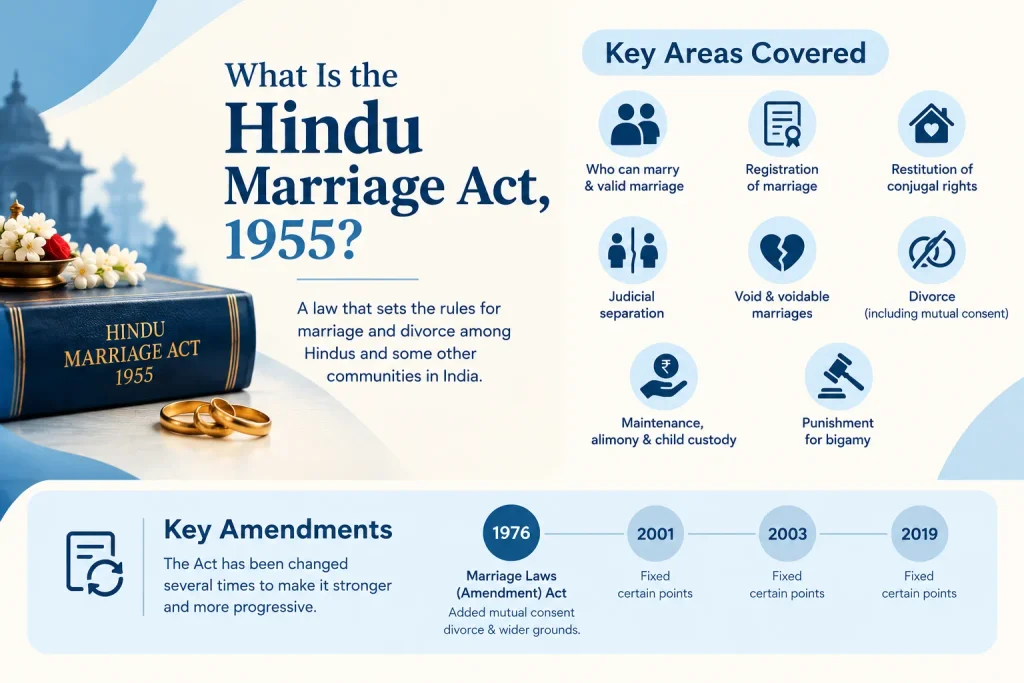
The Hindu Marriage Act (HMA) is an Indian law that was passed in 1955. It sets the rules for marriage and divorce among Hindus and some other communities. Before this law, rules were mixed and differed from place to place. The Act made them clear and equal across the country.
The Act deals with:
- Who can marry and how a marriage becomes valid
- Registration of marriage
- Restitution of conjugal rights (asking a spouse to come back)
- Judicial separation
- Void and voidable marriages
- Divorce, including mutual consent divorce
- Maintenance, alimony, and child custody
- Punishment for bigamy
The Act has been changed several times. The biggest change was the Marriage Laws (Amendment) Act, 1976. It added divorce by mutual consent and made the divorce grounds wider. Later changes in 2001, 2003, and 2019 fixed smaller points.
2. Who Is Covered Under the Hindu Marriage Act?
Many people think the Act is only for people who follow Hinduism. It is wider than that. Section 2 covers:
| Group | Covered? |
|---|---|
| Hindus in any form (including Virashaiva, Lingayat, Brahmo, Prarthana, Arya Samaj followers) | Yes |
| Buddhists | Yes |
| Jains | Yes |
| Sikhs | Yes |
| Children of Hindu, Buddhist, Jain, or Sikh parents | Yes |
| Converts to Hindu, Buddhist, Jain, or Sikh religion | Yes |
| Anyone living in India who is not a Muslim, Christian, Parsi, or Jew, unless proven that their own law applies | Yes |
| Muslims, Christians, Parsis, Jews | No (they follow their own laws) |
| Members of Scheduled Tribes | No, unless the Central Government says so by notice |
Do Sikhs Need Anand Karaj Registration or HMA?
Sikhs can register their marriage under the Anand Marriage Act, 1909. But for divorce, Sikhs still use the Hindu Marriage Act. So both laws matter for a Sikh couple.
Does the Act Apply to Hindus Living Abroad?
Yes, in many cases. The Act applies to Hindus who live in India. It also applies to Hindus who live outside India but are domiciled in India. NRIs often file in Indian courts. Which court can hear the case is decided by Section 19, explained in Rule 16.
3. Who Is Not Covered?
If you are Muslim, Christian, Parsi, or Jewish, this Act does not apply to you. Here is a quick comparison of the laws that apply instead.
| Community | Main Law for Marriage and Divorce |
|---|---|
| Hindu, Buddhist, Jain, Sikh | Hindu Marriage Act, 1955 |
| Muslim | Muslim personal law and the Dissolution of Muslim Marriages Act, 1939 |
| Christian | Indian Christian Marriage Act, 1872 and Indian Divorce Act, 1869 |
| Parsi | Parsi Marriage and Divorce Act, 1936 |
| Any religion (inter-faith or civil marriage) | Special Marriage Act, 1954 |
If a Hindu marries a Muslim under the Special Marriage Act, the Hindu Marriage Act will not apply to that marriage. The Special Marriage Act applies.
4. What Are the Conditions for a Valid Hindu Marriage? (Section 5)
Section 5 lists five conditions. If a marriage breaks these rules, it can be void or voidable.
The Five Conditions in Simple Words
| Sr No | Condition | What It Means |
|---|---|---|
| 1 | No living spouse | Neither person can have a husband or wife alive at the time of marriage |
| 2 | Sound mind | Both must be able to give valid consent. Serious mental disorder or repeated attacks of insanity can break this condition |
| 3 | Minimum age | Groom 21, bride 18 |
| 4 | Not in prohibited relationship | Close blood relatives cannot marry, unless a custom allows it |
| 5 | Not sapindas | People linked by a close family line (as the Act defines) cannot marry, unless a custom allows it |
What If the Age Rule Is Broken?
If the bride or groom is under the legal age, the marriage is not automatically void under the Hindu Marriage Act. But it is still against the law. The Prohibition of Child Marriage Act, 2006 can apply. The people who arranged the marriage can face punishment. The Act also gives a wife a special ground for divorce if she was married before 15 and rejected the marriage before turning 18.
5. Ceremonies and Saptapadi: When Is a Hindu Marriage Complete? (Section 7)
Section 7 says a Hindu marriage can be done by the customs of either side. If those customs include saptapadi (the seven steps taken together around the sacred fire), the marriage is complete and binding when the seventh step is taken.
This point is very important in court. A few common questions:
- Is a wedding at a court or an Arya Samaj temple enough: It can be, if the required rites were done. A certificate alone is not enough proof.
- Is a wedding by exchanging garlands enough: Only if that is a valid custom of the community and the rites follow Section 7.
- What did the Supreme Court say in 2024: In Dolly Rani v. Manish Kumar Chanchal, it said registration is only proof. The marriage must first be solemnised with proper ceremonies.
Why this matters: If someone says “we only got a certificate and never did the rites,” the marriage can be challenged. This can affect divorce, maintenance, and inheritance claims.
6. Registration of Hindu Marriage (Section 8)
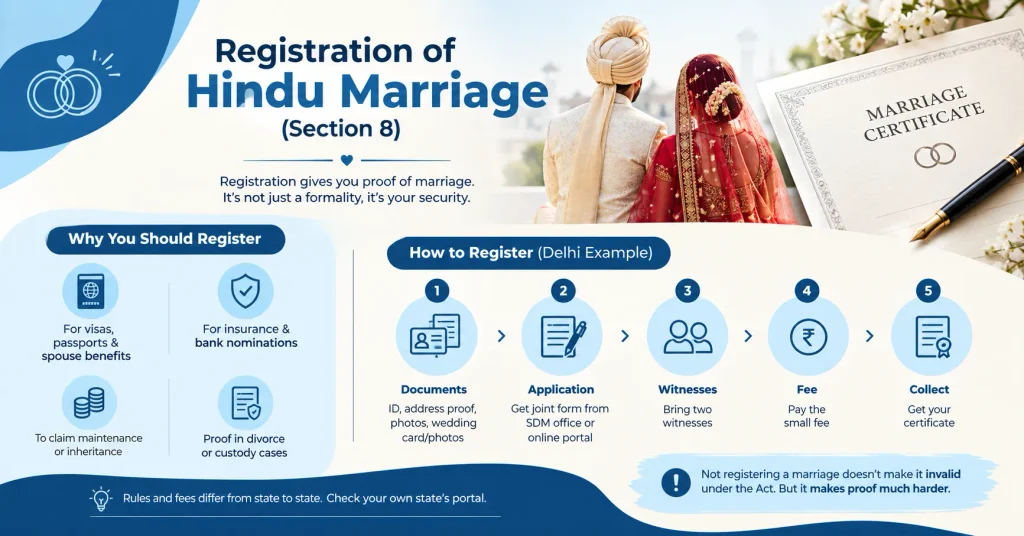
Section 8 lets each state make rules to register Hindu marriages. Registration gives you proof of marriage. In 2006, in Seema v. Ashwani Kumar, the Supreme Court said registration should be compulsory for all marriages in India, whatever the religion.
Why You Should Register
- Needed for visas, passports, and spouse benefits
- Needed for insurance and bank nominations
- Needed to claim maintenance or inheritance
- Gives proof in a divorce or custody case
How to Register (Delhi Example)
- Take both partners’ ID, address proof, photos, and wedding card or photos
- Get a joint application form from the SDM office or the state’s online portal
- Bring two witnesses
- Pay the small fee
- Collect the certificate
Rules and fees differ from state to state. Check your own state’s portal.
Not registering a marriage does not make it invalid under the Act. But it makes proof much harder.
7. Restitution of Conjugal Rights (Section 9)
It simply means: “I ask the court to tell my spouse to come back and live with me.”
If a husband or wife leaves without a good reason, the other person can file a petition under Section 9. The court may order them to live together again. The other side can reply that they had a good reason to leave, such as cruelty.
Why People Use Section 9
- To show they want to save the marriage
- To build a base for a divorce later
- To answer a desertion claim
If the spouse does not return after the decree, and one year passes, the other side can file for divorce under Section 13(1A).
8. Judicial Separation (Section 10)
Judicial separation means you stay legally married but live apart by a court order. You cannot remarry. It is like a “pause” button.
| Point | Judicial Separation | Divorce |
|---|---|---|
| Marriage ends? | No | Yes |
| Can you remarry? | No | Yes, after the waiting period |
| Grounds | Same grounds as divorce (Section 13) | Section 13 or 13B |
| Best for | People not ready to end the marriage | People who want a final end |
| Can it turn into divorce? | Yes, if no cohabitation for one year after the decree | Not applicable |
Many people choose judicial separation for religious or family reasons. It also gives time to think.
9. Void and Voidable Marriages: What Is the Difference? (Sections 11 and 12)
These two words confuse most beginners. Here is a clear table.
| Point | Void Marriage (Section 11) | Voidable Marriage (Section 12) |
|---|---|---|
| Meaning | Never valid from day one | Valid until a court cancels it |
| Who can ask the court? | Either person (and sometimes others in the right case) | Usually only the affected person |
| Is a court decree needed? | A decree is advised to clear doubts | Yes, a decree is a must |
| Common reasons | Spouse alive at time of marriage, prohibited relationship, sapinda relationship | Cannot consummate (impotence), mental disorder, consent by force or fraud, wife pregnant by another man at the time of marriage |
| Time limit | None for filing | Strict limits, for example about one year for force or fraud |
What About Children?
Section 16 protects children. A child born from a void or voidable marriage is treated as legitimate. In Revanasiddappa v. Mallikarjun (2023), the Supreme Court said these children also have rights in their parents’ property. This is a point many blogs skip.
10. Grounds for Divorce Under the Hindu Marriage Act (Section 13)
This is the part most people search for. Section 13 lists the reasons a court can grant a divorce.
Grounds Open to Both Husband and Wife (Section 13(1))
| Sr No | Ground | Simple Meaning |
|---|---|---|
| 1 | Adultery | Voluntary sexual relations with someone other than your spouse after marriage. Even one act can count |
| 2 | Cruelty | Physical or mental harm that makes it unsafe or very painful to live together |
| 3 | Desertion | Spouse left without good reason for at least 2 years just before filing |
| 4 | Conversion | Spouse changed religion and is no longer Hindu, Buddhist, Jain, or Sikh |
| 5 | Mental disorder | Spouse has an unsound mind or a mental disorder of a kind that you cannot reasonably be expected to live with |
| 6 | Venereal disease | A serious disease that can spread, in communicable form |
| 7 | Renunciation | Spouse gave up the world and joined a religious order |
| 8 | Missing for 7 years | Spouse not heard of as alive for 7 years by people who would normally hear from them |
Extra Grounds Only for Wives (Section 13(2))
- The husband already had another wife before the Act began, and that wife is alive
- The husband is guilty of rape, sodomy, or bestiality
- A maintenance order was passed in the wife’s favour and the couple has not lived together for one year or more after it
- The wife was married before age 15 and rejected the marriage before turning 18
Divorce After Judicial Separation or After Restitution (Section 13(1A))
Either spouse can ask for divorce if, after a decree of judicial separation or restitution of conjugal rights, the couple did not live together for one year or more.
What Is Cruelty?
Cruelty is not defined fully in the Act. Courts decide case by case. In Samar Ghosh v. Jaya Ghosh (2007), the Supreme Court gave examples of mental cruelty. Some examples that courts have looked at:
- Constant insults, abuse, or false charges
- Refusing to talk or live as a couple for long periods
- Threats of suicide or violence
- Long, unreasonable refusal of a normal married life
Small quarrels are not cruelty. Courts expect the behaviour to be serious and long enough to harm the other person.
What Is Desertion?
Desertion means leaving the other person without a good reason, without their consent, and with no plan to return. It must continue for at least two years right before the petition. A short separation or one caused by work or study is usually not desertion.
Is “Irretrievable Breakdown” a Ground?
Not in the text of the Act. But the Supreme Court can grant a divorce on this basis using Article 142 of the Constitution. It did so in Shilpa Sailesh v. Varun Sreenivasan (2023). Family courts and High Courts cannot use this power on their own.
Check complete Divorce Process in India
11. Divorce by Mutual Consent (Section 13B)
This section was added in 1976. It is the faster and calmer way to end a marriage.
Conditions for Section 13B
- You have lived separately for at least one year
- You cannot live together any more
- Both of you agree the marriage should end
Steps in Mutual Divorce
- Settle the terms. Talk about alimony, custody, property, and return of gifts.
- File a joint petition in the right family court.
- First motion. Both appear before the judge and statements are recorded.
- Waiting period. Six months by default. The court can waive it. The second motion must come within 18 months.
- Second motion. Both confirm they still agree.
- Decree. The court passes the divorce decree.
Can One Person Withdraw Consent?
Yes, but only before the final decree. Consent must still be there at the second motion. If one person withdraws, the case can fail. This is why a clear written settlement helps.
Mutual Divorce vs Contested Divorce
| Point | Mutual (Section 13B) | Contested (Section 13) |
|---|---|---|
| Agreement | Both agree | One spouse fights |
| Grounds needed | None, only agreement and one year apart | Yes, you must prove a ground |
| Usual time | About 6 to 18 months (less if the wait is waived) | Often 2 to 6 years or more |
| Cost | Lower | Higher |
| Stress | Lower | High |
Documents You May Need
- Marriage certificate and wedding photos
- ID and address proof of both
- Proof of living apart for one year
- Income proof (ITR, salary slips)
- Signed settlement agreement
- Children’s birth certificates, if any
12. The One-Year Rule and Remarriage (Sections 14 and 15)
No Divorce in the First Year (Section 14)
You cannot usually file for divorce within one year of marriage. A court can allow an earlier petition in a case of exceptional hardship or exceptional bad behaviour by the other spouse. The aim is to stop hasty petitions.
When Can You Marry Again? (Section 15)
After a divorce decree, you can marry again only when:
- The time to appeal has ended and no appeal was filed, or
- An appeal was filed and dismissed
Remarrying before that can cause serious legal trouble. Many people miss this rule and later face a challenge to the new marriage.
13. Alimony and Maintenance (Sections 24 and 25)
Interim Maintenance (Section 24)
While the case is running, the spouse who cannot support themselves can ask for monthly money and court costs. Either husband or wife can ask. The law says the court should try to decide this application within 60 days of notice to the other side.
Permanent Alimony (Section 25)
When the divorce is granted, or after it, the court can order a lump sum or monthly payment. The court looks at:
- Income and property of both
- How the couple lived during the marriage
- Age, health, and needs
- Conduct of both sides
- Care of children
Alimony Table: Quick View
| Point | Interim Maintenance | Permanent Alimony |
|---|---|---|
| Section | 24 | 25 |
| When | During the case | At or after the decree |
| Who can claim | Husband or wife | Husband or wife |
| Form | Monthly amount plus case costs | Lump sum or monthly payment |
| Can it change later? | Yes, with a new application | Yes, if conditions change |
Affidavit of Assets: A Rule from 2020
In Rajnesh v. Neha (2020), the Supreme Court said both spouses must file a full affidavit of income, assets, and debts in maintenance cases. This helps the court decide a fair amount and reduces false claims. Hiding income can hurt your case.
Other Laws for Maintenance
- BNSS Section 144 (earlier CrPC 125): maintenance for wife and children
- Protection of Women from Domestic Violence Act, 2005: monthly relief and the right to live in the shared home
A wife can use these laws together. The court will not allow double recovery for the same period.
14. Child Custody and Children’s Rights (Sections 26 and 16)
Custody (Section 26)
The court can make orders about the custody, education, and upkeep of minor children at any time in the case, and even after the decree. The child’s welfare is the main test. The parents’ wishes come second. The law also says such applications should try to be decided within 60 days of notice.
Common Custody Types
| Type | Meaning |
|---|---|
| Physical custody | The child lives with one parent |
| Joint custody | Both parents share time and decisions |
| Visitation | The other parent meets the child on a fixed schedule |
| Guardianship | Legal power to make big decisions for the child |
Very young children often stay with the mother, but this is not a fixed rule. Courts also listen to older children.
Legitimacy of Children (Section 16)
Children of void or voidable marriages are treated as legitimate. They have rights in their parents’ property, as the Supreme Court said in 2023.
Check How to Get Full Custody of a Child
15. Property and Gifts (Section 27)
Section 27 lets the court decide how to divide property that was given at or around the time of marriage and belongs jointly to both spouses. This can include gifts given to the couple together.
Stridhan Is Different
Stridhan is the wife’s own property, such as gifts to her from her family, friends, or in-laws. The wife is the sole owner. Courts have said a husband or in-laws who refuse to return stridhan can face legal action.
The Hindu Marriage Act does not give an automatic share in the husband’s property. Property fights are settled through alimony, settlement, or other laws on property.
16. Courts, Jurisdiction and Time Limits (Sections 19, 21B, 28)
Which Court Can Hear Your Case? (Section 19)
A petition can be filed in the District Court or Family Court in whose area:
- The marriage took place, or
- The other spouse lives at the time of filing, or
- The couple last lived together, or
- The wife lives, if she is the petitioner, or
- The petitioner lives, if the other spouse is outside India or has not been heard of for 7 years
Delhi Family Courts
In Delhi, family cases are filed in family courts at Tis Hazari, Saket, Dwarka, Rohini, Karkardooma, and Patiala House, depending on the area.
Time Limits Table
| Step | Time in the Act |
|---|---|
| Trial of a petition | Aim to finish within 6 months from notice (Section 21B) |
| Hearing of an appeal | Aim to finish within 3 months from notice of appeal (Section 21B) |
| Time to file an appeal | 90 days from the decree (Section 28) |
| Interim maintenance | Aim to decide within 60 days (Section 24) |
These are targets, not strict deadlines. In real life, busy courts take longer. Contested divorces often take years.
Privacy (Section 22)
Hearings are held “in camera,” which means in private. It is also illegal to print or publish details of the proceedings without court permission.
17. Bigamy and Other Punishments (Sections 17 and 18)
If a Hindu marries again while the first spouse is alive, the second marriage is void. The person can also be punished for bigamy. Since July 2024, the punishment section is BNS Section 82.
For a bigamy case, the second marriage must usually be proven to have the required ceremonies, such as saptapadi. Section 18 also punishes breaking some other marriage conditions, such as the age rule and the prohibited relationship rules.
Hindu Marriage Act vs Special Marriage Act: Which One Fits You?
This comparison is missing from most blogs.
| Point | Hindu Marriage Act, 1955 | Special Marriage Act, 1954 |
|---|---|---|
| Who can use it | Hindus, Buddhists, Jains, Sikhs | Any person, any religion |
| Type of marriage | Religious ceremony | Civil marriage |
| Notice before marriage | Not needed | 30 days notice to the Marriage Officer |
| Registration | Optional by Act, but advised and now compulsory under court direction | Compulsory |
| Minimum age | Groom 21, bride 18 | Groom 21, bride 18 |
| Mutual divorce | Section 13B | Section 28 |
| Best for | Couples of the same faith | Inter-faith couples or those who want a civil marriage |
Common Myths About the Hindu Marriage Act
Myth 1: “Seven years apart gives an automatic divorce.”
No. You must still file a case. The 7-year rule in the Act is about a spouse who is missing and not heard of as alive.
Myth 2: “A marriage certificate is enough to prove a Hindu marriage.”
No. The ceremonies must also have taken place, as the Supreme Court said in 2024.
Myth 3: “The wife gets half of the husband’s property.”
No. The Act does not give such a share. The court decides alimony based on the facts.
Myth 4: “Only men can be asked to pay alimony.”
No. A wife with higher income can be asked to pay maintenance to a husband who cannot support himself.
Myth 5: “Mutual divorce always takes 18 months.”
No. 18 months is the outer limit. With a waiver, it can be much shorter.
Mistakes to Avoid When Dealing With the Hindu Marriage Act
- Signing a settlement without understanding it
- Hiding income or property in a maintenance case
- Marrying again before the appeal time ends (Section 15)
- Assuming a certificate alone proves the marriage
- Missing the 90-day appeal time
- Copying the law from old websites that show removed grounds like leprosy
- Using children as a tool in custody fights
Should You Hire a Lawyer?
You can go to court without a top lawyer. But family law has strict steps, forms, and time limits. A good family lawyer can help with drafting, filing, and negotiation. Women and children can also get free legal aid under the Legal Services Authorities Act through the Delhi State Legal Services Authority. The NALSA helpline number is 15100.
If you want help finding a lawyer in the capital, read our guide to the top divorce lawyers in Delhi.
How We Checked This Guide (EEAT Note)
- The section list and titles were checked against the Act’s section index (37 sections including lettered ones).
- Time limits were taken from the Act’s own sections (13B, 14, 21B, 24, 26, 28).
- Case names are Supreme Court decisions: Samar Ghosh (2007), Seema (2006), Rajnesh (2020), Shilpa Sailesh (2023), Revanasiddappa (2023), Dolly Rani (2024).
- The 2026 waiver update comes from reports of a Supreme Court order dated 2 February 2026, a Delhi High Court Full Bench ruling of December 2025, and a Madras High Court order of February 2026. Please check the official judgments before you quote them.
- Official text sources: India Code, Delhi High Court (thc.nic.in), and Indian Kanoon Etc.
Conclusion
The Hindu Marriage Act is not as hard as it looks. At its core, it answers five simple questions: Who does it cover? What makes a marriage valid? When can a couple separate? How is money handled? And what happens to the children?
Know your section numbers, keep your papers safe, and never rely on old websites. If you are planning a marriage, register it and keep proof of your ceremony. If you are planning a divorce, think about mutual consent first, because it saves time and money, and the 2026 rulings on the waiting period may help you.
When in doubt, talk to a family lawyer. A short meeting now can save years later.
FAQs
1. What is the Hindu Marriage Act, 1955?
It is an Indian law that sets the rules for marriage and divorce among Hindus, Buddhists, Jains, and Sikhs. It covers valid marriage, separation, divorce, maintenance, and custody.
2. Who is covered under the Hindu Marriage Act?
Hindus in any form, Buddhists, Jains, Sikhs, and anyone who is not a Muslim, Christian, Parsi, or Jew unless their own law is shown to apply. Scheduled Tribes are outside it unless the Central Government says otherwise.
3. What is the minimum age to marry under the Hindu Marriage Act?
21 for a man and 18 for a woman.
4. What are the grounds for divorce under the Hindu Marriage Act?
Adultery, cruelty, desertion for 2 years, conversion, mental disorder, venereal disease, renunciation, and a spouse missing for 7 years. Wives have a few extra grounds.
5. What is Section 13B of the Hindu Marriage Act?
It allows divorce by mutual consent. Both must have lived apart for at least one year and agree the marriage should end.
6. How long does a mutual divorce take?
Usually 6 to 18 months. It can be quicker if the court waives the six-month wait.
7. Can the 6-month cooling period be waived?
Yes. The Supreme Court has said it is directory, and 2026 orders show courts waiving it when there is no chance of reconciliation. The judge decides each case.
8. What is restitution of conjugal rights?
It is a petition asking the court to order a spouse who left to return and live with you (Section 9).
9. What is the difference between void and voidable marriage?
A void marriage is invalid from the start. A voidable marriage is valid until a court cancels it.
10. Is a marriage certificate enough to prove a Hindu marriage?
No. The ceremonies required by Section 7 must also have been done, as the Supreme Court said in 2024.
11. Does the Hindu Marriage Act give a wife a share in the husband’s property?
No automatic share. The court can order alimony or maintenance under Sections 24 and 25.
12. Can a husband claim alimony under the Hindu Marriage Act?
Yes. Either spouse can ask for interim maintenance or permanent alimony if they cannot support themselves.
13. Is there a 7-year rule in the Hindu Marriage Act?
Yes, but it is about a missing spouse. If a spouse has not been heard of as alive for 7 years, the other can seek divorce. Living apart for 7 years does not give an automatic divorce.
14. When can I remarry after divorce?
Only after the time for appeal has ended with no appeal, or after an appeal is dismissed (Section 15).
15. Where can I read the Hindu Marriage Act PDF?
Use official sources such as India Code or the Delhi High Court website. Be careful with random PDFs, as they may be old and miss amendments.