


Most people meet the Transfer of Property Act when something big happens in life. A family wants to give a flat to a child. A buyer pays money for a plot and then finds the seller never registered it. A tenant gets a notice. A law student starts the first year and sees a thick book on the table.
The Act is old, but it is still used every day in courts, banks and sub-registrar offices. It tells you who can transfer property, what can be transferred, how it must be done, and what rights each side gets. In this blog, we explain it step by step in simple words. We cover the main sections, the five types of transfer, important doctrines, the amendments, recent Supreme Court views, and practical tips for people who want to transfer property to a family member.
Students will find a quick notes table. Buyers and owners will find clear do’s and don’ts. Everything here is general information, not legal advice. For your own case, speak to a property lawyer.
TL;DR (Quick Summary)
- The Transfer of Property Act, 1882 (TP Act) is the main Indian law that explains how a living person can transfer property to another person. It came into force on 1 July 1882.
- It covers five main kinds of transfer: sale, mortgage, lease, exchange and gift. It also covers actionable claims, such as a right to recover a debt.
- It does not cover wills or inheritance. Those come under succession laws.
- A sale of immovable property worth more than Rs. 100 needs a registered sale deed. An agreement to sell, a power of attorney or a will does not make you the owner.
- A gift of immovable property needs a registered deed, two witnesses, and acceptance by the receiver while the giver is alive.
- We found no new change to the Act’s text in 2025 or 2026. The main updates came in 2001, 2002 and 2019. Recent Supreme Court rulings keep repeating one message: registration matters.
- You can read the official text on India Code and the Legislative Department website. Always check the official copy before you rely on any section.
Where to Read the Transfer of Property Act (PDF and Bare Act)
Many people search for the Transfer of Property Act PDF or the bare act. Use official or trusted sources, because old copies online may miss amendments.
| Source | What you get | Good for |
|---|---|---|
| India Code (indiacode.gov.in) | Official, updated text of the Act | Checking the current wording |
| Legislative Department (legislative.gov.in) | Official copy of the Act | Printing or saving a PDF |
For books, law students often use Mulla’s Transfer of Property Act, the Transfer of Property Act by Dr. R.K. Sinha, and Property Law by Dr. Poonam Pradhan Saxena. Check that you are buying the latest edition. For exams, keep a bare act with you, since you must know the exact section numbers.
What Is the Transfer of Property Act, 1882?

The full purpose of the Act is written in its long title: it amends the law about the transfer of property by act of parties. That last phrase is important. The Act deals with transfers that people choose to make. It does not deal with transfers that happen by law, such as inheritance after a death, or by a court order.
The Act was passed on 17 February 1882 and started working from 1 July 1882. It has about 137 sections spread over eight chapters. Some sections have been repealed over the years. The Act is a central law, but a few states have made local changes, so rules on stamp duty and registration charges differ from state to state.
Who and What the Act Covers
- Transfers between living people: Lawyers call these inter vivos transfers. A will does not work during the owner’s life, so it is outside this Act.
- Mostly immovable property: Land, houses and flats are the main focus. Some parts, like gifts and actionable claims, also touch movable property.
- Muslim gifts are kept apart: Section 129 says that gifts under Muslim law and certain death-bed gifts are not affected by the chapter on gifts.
- Companies and other legal bodies: The Act does not stop special laws that govern their transfers.
Key Words You Should Know
- Transfer of property: An act by which a living person conveys property to one or more other living persons, now or in the future (Section 5). A company or an association can also be a person here.
- Immovable property: Land, things attached to the earth like buildings and trees with roots, and benefits that come out of land. Standing timber, growing crops and grass are not immovable property under the Act.
- Attested: Signed by at least two witnesses, each of whom saw the owner sign or got a personal acknowledgement from the owner, and each of whom signed in the owner’s presence.
- Actionable claim: A right to recover a debt or to claim a benefit that is not in your possession, such as an unpaid bill.
- Notice: Knowing a fact, or being in a position where you should have found it out with normal care.
Chapter-Wise Overview (Quick Notes)
| Chapter | Sections | Topic | Easy meaning |
|---|---|---|---|
| I | 1 to 4 | Preliminary | Name, start date, meaning of words |
| II | 5 to 53A | Transfer by act of parties | General rules for all transfers |
| III | 54 to 57 | Sale | Ownership passes for a price |
| IV | 58 to 104 | Mortgage and charges | Property given as security for a loan |
| V | 105 to 117 | Leases | Right to enjoy property for rent |
| VI | 118 to 121 | Exchanges | Swap of one property for another |
| VII | 122 to 129 | Gifts | Transfer without money |
| VIII | 130 to 137 | Actionable claims | Transfer of debts and similar rights |
What Property Can Be Transferred? What Cannot Be Transferred?
Section 6 gives the main rule. Property of any kind may be transferred, unless a law says otherwise. Then it lists things that cannot be transferred. This is a very common exam question and a common search, so here is a clear list.
| What cannot be transferred | Simple explanation |
|---|---|
| Chance of an heir succeeding | You cannot sell the hope of getting a relative’s property after the relative dies. It is not yet a right. |
| Chance of a relation’s legacy or a similar hope | A mere hope of a gift or bequest cannot be sold. |
| Right of re-entry | A landlord’s right to take back the property on breach of a condition cannot be passed to someone who does not own the property. |
| Easement apart from the dominant property | A right like a path through a neighbour’s land cannot be sold alone. It goes with the main property. |
| Interest limited to the owner’s personal enjoyment | If the right only benefits the owner personally, it cannot go to another person. |
| Right to future maintenance | A person’s right to receive support in the future cannot be sold. |
| A mere right to sue | A bare right to go to court cannot be sold on its own. |
| Public office or salary of a public officer | The post and its pay, as well as pensions and stipends that are exempt by law, cannot be transferred. |
| Stipends allowed by law to be exempt from attachment | They are meant to support the person. |
| Transfers for an unlawful purpose | For example, a transfer made to defeat a law. |
| Transfers to a person who is legally incompetent | A transfer to a person who the law does not allow to receive the property. |
Two more points matter. A tenant with a right of occupancy that cannot be passed on by law cannot transfer it. Also, Section 6 does not stop a transfer which is allowed by some other law. So always check the special law as well.
Who Can Transfer Property? (Section 7)
A person can transfer property if he or she is competent to make a contract and is entitled to the property, or is authorised to dispose of it. A minor cannot sign a binding sale. A person of unsound mind cannot make a valid transfer. But a minor can receive a property, such as a gift, because receiving does not need a contract.
Other Important General Rules
- Section 8: When a property is transferred, everything the owner can legally pass on goes with it, unless there is a clear term saying otherwise. For a house, this includes the land under it and the things attached to it.
- Section 9: A transfer can be oral unless the law needs a written document. For most immovable property, a written and registered document is needed.
- Section 10: If a transfer says the buyer can never sell or give away the property, that condition is void. The law does not like a total ban on selling.
- Section 11: If a transfer says the buyer must use the property in a certain way, the buyer must follow that term.
- Section 14: The rule against perpetuities. A transfer cannot tie up property for too long in the future. The interest must start within the life of persons alive at the time plus the age of majority of a person born later.
- Sections 19 and 21: A vested interest is a present right to enjoy later. A contingent interest depends on something that may or may not happen.
Key Doctrines Under the Transfer of Property Act
These six rules cause the most disputes. Learn them well.
1. Ostensible Owner (Section 41)
Sometimes the person looks just like the real owner, but isn’t. If the real owner allows this to happen and a buyer pays a fair price in good faith after reasonable care, the buyer’s title is protected. The real owner cannot later say that the seller had no right. The word to remember is good faith. The rule does not apply where a buyer ignores obvious warning signs.
2. Feeding the Grant by Estoppel (Section 43)
If a person wrongly says he owns a property and sells it, and later he actually gets the right to that property, the buyer can ask for the transfer to take effect from then. Example: A sells a plot he does not own to B. Later A inherits the plot. B can ask the court to treat the sale as valid now, unless another person with notice of the first deal has acquired rights.
3. Lis Pendens (Section 52)
This means ‘a pending suit’. If a court case about a property is going on, nobody can transfer that property in a way that hurts the other party’s rights in the case. Anyone who buys it during the case takes the property subject to the final decision. That is why buyers must check whether any case is pending before they buy. A search at the court and the registrar’s office helps.
4. Fraudulent Transfer (Section 53)
A person who makes a transfer of property with intent to defraud his creditors may petition the court to set the transfer aside. The law also protects a buyer who buys in good faith and for a fair price without knowledge of the true purpose.
5. Part Performance (Section 53A)
Suppose you made a written agreement to buy a property, paid the money and took possession of it. Then the seller won’t close the sale. Section 53A can save you from being kicked out by the seller. But look at the limits. It defends possession as a defence. It does not make you an owner . If you want to use this protection, the agreement must be registered (following changes to the Registration Act in 2001). Courts, including the Supreme Court, have described Section 53A as a shield and not a sword.
6. Election (Section 35)
If a person gets a benefit under a document and the same document also takes away some of their own property, they must choose. They cannot take the benefit and also keep the property that the document gave to someone else.
Sale of Immovable Property (Sections 54 to 57)
Section 54 says a sale is a transfer of ownership in exchange for a price that has been paid, promised, or part-paid and part-promised.
- If the property is worth Rs. 100 or more, or if it is a reversion or an intangible thing, the sale can be made only by a registered instrument.
- If the property is a tangible immovable property worth less than Rs. 100, it can be sold by a registered instrument or by delivery of possession. In practice, almost every sale today is by registered deed.
- Ownership passes when the registered sale deed is executed. It does not depend on full payment unless the parties agree.
Agreement to Sell Is Not a Sale
This is the most important point for buyers. Section 54 itself says that a contract for sale does not by itself create any interest in the property. It only gives you a right to enforce the deal in court. Paying money and getting possession does not change this.
The Supreme Court has said this over and over again. In Suraj Lamp and Industries v. State of Haryana (2011), it ruled that sales carried out through an agreement to sell, a general power of attorney and a will (popularly known as SA/GPA/Will deals) do not transfer title. Again in 2025, in Vinod Infra Developers v. Mahaveer Lunia, the Court held that an unregistered agreement to sell, even with possession and payment does not give title.
Rights and Duties of the Seller and Buyer (Section 55)
| Seller must | Buyer must |
|---|---|
| Tell the buyer about any hidden defect in the property or title that the seller knows | Tell the seller of any fact that increases the value of the property, if the seller does not know it |
| Answer the buyer’s questions about title and show documents | Pay the price on time and take possession |
| Execute the sale deed and give possession | Bear the loss if the property is damaged after the sale, unless the seller is at fault |
| Take care of the property until the sale is done | Pay the public charges and rents from the date of sale |
Mortgage and Charge (Sections 58 to 104)
A mortgage is a transfer of an interest in a specific property as security for a loan. The person who gives the property is the mortgagor. The lender is the mortgagee. The Act names six types.
| Type | How it works |
|---|---|
| Simple mortgage | The borrower stays in possession and promises to repay. If he fails, the lender can sell the property through a court. |
| Mortgage by conditional sale | The property is sold on a condition. If the borrower repays on time, the sale ends. If not, the sale becomes final. |
| Usufructuary mortgage | The lender takes possession and enjoys rent or profits from the property until the loan is cleared. |
| English mortgage | The borrower transfers the property absolutely, with a promise to take it back on repayment. |
| Mortgage by deposit of title deeds | The borrower hands over the title documents to the lender. This is also called an equitable mortgage and is common with banks. |
| Anomalous mortgage | Any mortgage that does not fit the types above, such as a mix of two. |
Some basic rules matter. A mortgage worth Rs. 100 or more must be made by a registered instrument that is attested by two witnesses. A mortgage by deposit of title deeds is the exception and does not need registration, but it is allowed only in certain towns notified by the state. Under Section 60, the borrower has a right to redeem, which means to get the property back after paying the loan. Courts do not allow any term that blocks this right. This is called a clog on redemption.
Lease of Immovable Property (Sections 105 to 117)
A lease is the transfer of a right to enjoy a property for a fixed time or from year to year, for a price paid or promised. The giver is the lessor. The receiver is the lessee. The price is called rent.
- Registration (Section 107): A lease for more than one year, or one that reserves yearly rent, must be made by a registered instrument. Other leases can be made by a registered instrument or by delivery of possession.
- Notice to end a lease (Section 106): After the 2002 amendment, a lease from year to year or for a term more than one year needs six months’ notice. A month-to-month lease needs 15 days’ notice. A notice must be in writing, signed, and either sent by post or handed over. A notice is not invalid only because its period is a little short, if the case is filed after the full period has passed.
- Rights of the lessee: to enjoy the property, to get repairs the lessor has agreed to do, and to remove things he has fixed to the land.
- Duties of the lessee: to pay rent, to use the property for the agreed purpose, and to return it at the end.
In many states, rent control laws also apply to old tenancies and may override some of these rules. So read the local law as well.
Exchange (Sections 118 to 121)
An exchange happens when two people mutually transfer the ownership of one thing for the ownership of another. Neither thing is money. If both things are immovable property, or one is immovable property, the exchange must be done by a registered instrument. Most rules of sale apply to exchange as well.
Gift (Sections 122 to 129)
A gift is the transfer of existing movable or immovable property, made voluntarily and without money, by one person to another, and accepted by or for the receiver. The giver is the donor and the receiver is the donee.
What a Valid Gift Needs
- Voluntary and without consideration: There must be no price.
- Existing property: You cannot gift property you may get in the future. A gift of future property is void.
- Acceptance: The donee must accept the gift while the donor is alive and still able to give. If the donee dies before accepting, the gift is void.
- Registered deed for immovable property: The deed must be signed by or for the donor and attested by at least two witnesses.
- For movable property: a registered deed or delivery of the thing.
Gifts That Do Not Work
- A gift of all your present and future property is void (Section 124).
- A gift to several persons, where one does not accept, is void for that person’s share (Section 125).
- A gift made as a mix of good and bad things (onerous gift) cannot be accepted in part. If the receiver takes the benefit, he must also take the burden (Section 127).
Can a Gift Be Cancelled? (Section 126)
It’s hard to take back a gift. A gift may be revoked only if the donor and donee agree in advance that a gift will be revoked on a certain event that does not depend on the will of the donor or on the grounds that would revoke a contract, such as fraud. A donor can’t just change their mind and demand their donation back. Courts follow this to a T. Gifts that are registered and accepted are complete and cannot be unilaterally revoked, and the Supreme Court has held in 2024 and 2025 that possession is not always necessary to perfect a gift.
A Supreme Court ruling in early October 2026 added another warning. The gift of land was held incomplete where there was no registered gift deed attested by two witnesses and the donor’s title remained with him. A mere family understanding or a statement in a partition paper was insufficient.
Actionable Claims (Sections 130 to 137)
An actionable claim can be transferred by a written and signed document. Registration is not needed. The transfer is complete when the document is signed. But the person who owes the debt is not bound until he gets notice of the transfer. Until then, he can still pay the original creditor and be safe.
What Is the Best Way to Transfer Property to a Family Member?
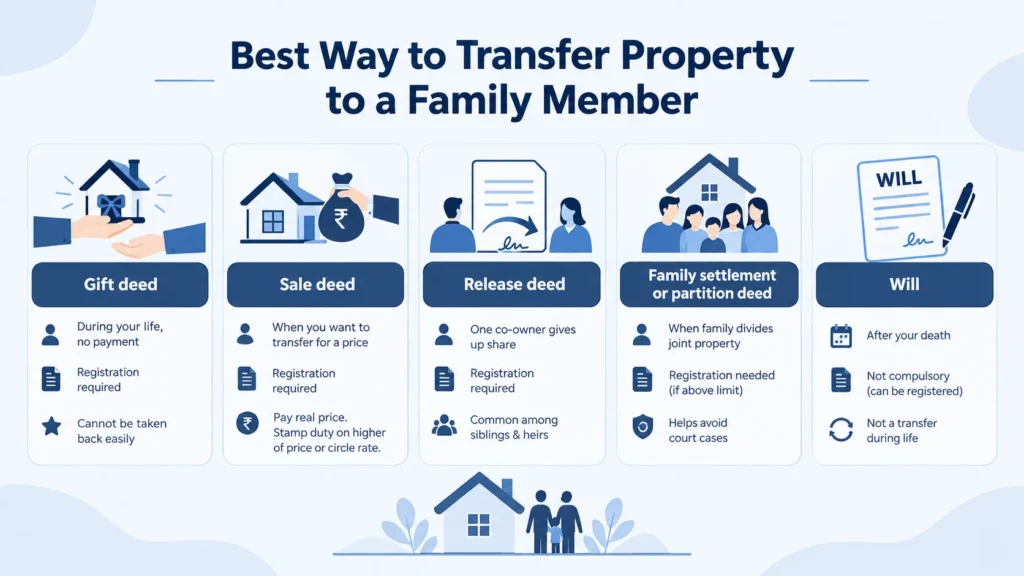
This is one of the most searched questions. There is no single best method. The right choice depends on your goal, your tax position and your family. The table below compares the usual options.
| Method | Works when | Registration | Key points |
|---|---|---|---|
| Gift deed | You want to give property during your life without payment | Required for immovable property | Cannot be taken back easily. Stamp duty depends on the state and is sometimes lower for close relatives. |
| Sale deed to a family member | You want to transfer ownership for a price | Required | Pay the real price. Stamp duty is charged on the higher of the price or the circle rate in many states. |
| Release deed | One co-owner gives up his share to another co-owner | Required | Common among brothers, sisters and heirs sharing inherited property. |
| Family settlement or partition deed | Family members divide joint property | Needed if it creates or ends rights in immovable property above the limit | Works well to avoid court cases. |
| Will | You want the transfer to happen after your death | Not compulsory, but can be registered | Is not a transfer during life. The owner can change it at any time. |
A few practical steps help in any case:
- Check the title papers. Make sure you are the full owner and that no loan or case is pending on the property.
- Choose the method that fits your goal. Ask whether you want the transfer now or after your death, and whether you want to keep the right to change your mind.
- Get a lawyer to draft the deed. Include a clear description of the property, boundaries, the survey or khasra number, and the names of both parties.
- Pay stamp duty as per your state’s rules. Rates differ widely, and some states give a rebate for transfers to certain relatives or to women.
- Register the deed at the sub-registrar’s office. Under the Registration Act, a document must be presented within four months of signing.
- Apply for mutation in the revenue or municipal records. Mutation is not proof of ownership, but it helps with property tax and later sale.
- Talk to a chartered accountant about tax. Income tax rules treat gifts from close relatives differently from gifts from others. They can also affect capital gains when the receiver sells later.
One more caution. Many families try to save time with a general power of attorney or an unregistered agreement. The Supreme Court has said these do not transfer ownership. Spending a little on a proper registered deed can save years of court time.
Registration and Stamp Duty: How They Connect to the TP Act
The Transfer of Property Act says what kind of document is needed. The Registration Act, 1908 explains how to register it, and the Indian Stamp Act and state stamp laws decide how much duty you pay. Here is how they fit together:
- Section 17 of the Registration Act – Lists documents that must be registered, including a sale, gift or lease of more than one year of immovable property.
- Section 49 of the Registration Act – Says that a document that must be registered but is not registered cannot affect the property, with some limited uses.
- Stamp duty – Is a state subject, so the rate changes by state and sometimes by city, type of property and who the buyer is. Always check the current rate with the sub-registrar’s office or the state’s official website.
Latest Amendment to the Transfer of Property Act
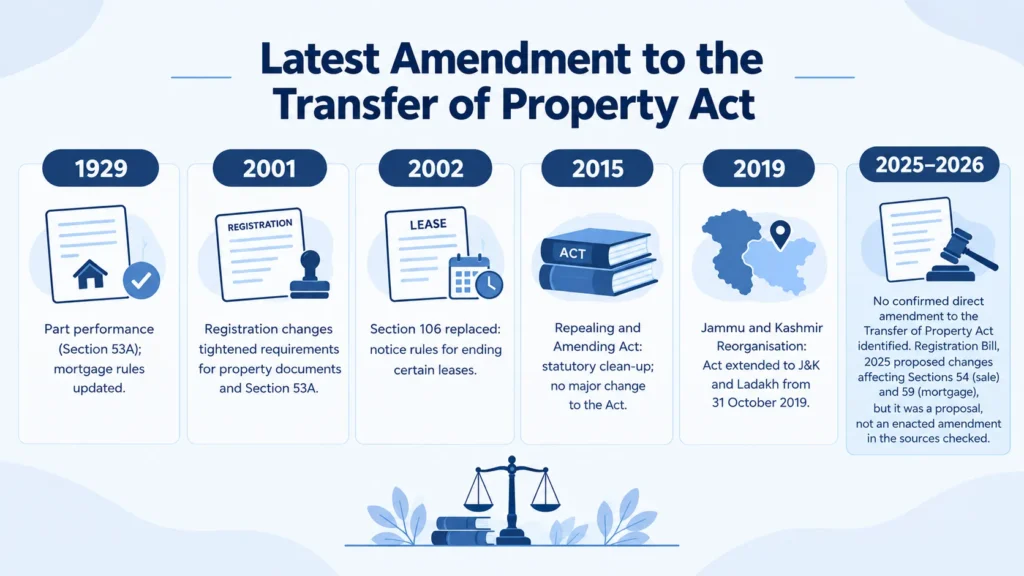
People often ask for the latest amendment, so here is an honest summary. The Act is old, but its main structure has stayed stable. These are the main changes:
| Year | Change | What it did |
|---|---|---|
| 1929 | Transfer of Property (Amendment) Act | Brought in Section 53A on part performance and updated mortgage rules |
| 2001 | Registration and Other Related Laws (Amendment) Act | Made registration a clear need under sections such as sale, mortgage, lease and gift, and tightened Section 53A |
| 2002 | Transfer of Property (Amendment) Act, 2002 | Replaced Section 106 on notice to end a lease |
| 2015 | Repealing and Amending Act | Cleaned up older amending laws, without changing the main Act |
| 2019 | Jammu and Kashmir Reorganisation Act | Extended the Act to the Union Territories of Jammu and Kashmir and Ladakh, from 31 October 2019 |
In 2026, Parliament passed the Jan Vishwas (Amendment of Provisions) Act, 2026, which changed provisions in many central laws to reduce criminal penalties. We did not find the Transfer of Property Act listed among the laws it changed, and the Act has no criminal sections of its own. Since this can change, please check the current text on India Code before quoting any section in a legal document or exam.
The Law Commission of India has also studied the Act. It has published reports on the whole Act (Report No. 70, 1977), on Section 52 (Report No. 157, 1998) and on Section 106 (Report No. 181, 2002). Some commentators suggest reforms, such as clearer rules for electronic documents and for delayed possession, but these are suggestions and not law.
Recent Supreme Court Judgments on the Transfer of Property Act
Another common search is the latest Supreme Court judgment on the TP Act. Many rulings in 2024 to 2026 keep coming back to the same few ideas. This table gives the main themes.
| Theme | What the Supreme Court said | Why it matters to you |
|---|---|---|
| Registered sale deed is a must | In Sanjay Sharma v. Kotak Mahindra Bank (December 2024), the Court said ownership does not pass until the sale deed is registered, even if you paid and got possession. | Do not treat a receipt or possession as ownership. |
| Agreement to sell | In rulings in January 2025, mid-2025 (Vinod Infra Developers v. Mahaveer Lunia) and September 2025, the Court repeated that an agreement to sell does not create an interest in the property. | You can sue for specific performance, but you are not the owner until the deed is registered. |
| SA/GPA/Will deals | The Court has followed Suraj Lamp (2011) and said such deals cannot replace a registered sale deed. A will also needs proper proof under succession and evidence laws. | Avoid power-of-attorney sales. |
| Gift deeds | The Court has held that a registered and accepted gift is complete and cannot be cancelled by the donor alone. A gift without a registered deed and two witnesses is incomplete. | Plan a gift carefully. Once done, it is hard to undo. |
| Section 53A | The Court has described part performance as a defence for a person in possession, not a way to claim title. | Use it only as protection while you finish the sale. |
These notes are a short summary for general reading. Each judgment has its own facts, so read the full order or ask a lawyer before you rely on it.
Common Mistakes People Make
- Paying full money and taking possession without a registered sale deed.
- Buying through a power of attorney because it looks cheaper.
- Not checking for a pending court case on the property before buying.
- Making a gift orally or on plain paper and expecting it to be valid.
- Forgetting to get two witnesses to sign a gift deed or mortgage deed.
- Ignoring the four-month time limit to present a document for registration.
- Assuming mutation in the records means ownership.
- Trusting an old PDF of the Act without checking the official version.
Quick Revision Notes for Law Students
- Section 5: Meaning of transfer.
- Section 6: What can and cannot be transferred.
- Section 7: Who can transfer.
- Section 41: Ostensible owner.
- Section 43: Feeding the grant by estoppel.
- Section 52: Lis pendens.
- Section 53: Fraudulent transfer
- Section 53A: Part performance.
- Section 54: Sale and contract for sale.
- Section 58: Mortgage and its six types.
- Section 60: Right of redemption.
- Section 105: Lease.
- Section 106: Notice to end a lease.
- Section 107: How a lease is made.
- Section 118: Exchange.
- Section 122: gift.
- Section 123: How a gift is made.
- Section 126: Revocation of a gift.
- Section 130: Transfer of an actionable claim.
Keep one case for each doctrine ready for exams, and always write the section number first.
Conclusion
The Transfer of Property Act, 1882 may be more than 140 years old, but it still sits at the centre of every property deal in India. Its main message is simple. A valid transfer needs a person who can legally transfer, property that can be transferred, and the right document, usually a registered one. Sale, mortgage, lease, exchange and gift each have their own rules, and the rules on registration and witnesses are not optional.
If you are buying, insist on a registered sale deed and check pending cases. If you’re giving property to a family member, choose the method that meets your goal, and get it drafted and registered correctly. If you are a student, learn the important sections and the six doctrines and keep the bare act handy. And however you use this guide, always check the official text on India Code, as law and court views can change.
FAQs
1. What is the Transfer of Property Act, 1882?
It is the central law that explains how a living person can transfer property to another person in India. It covers sale, mortgage, lease, exchange, gift and actionable claims. It came into force on 1 July 1882.
2. What property cannot be transferred under the TP Act?
Section 6 lists them. Examples are a mere chance of inheriting property, a right of re-entry, an easement apart from the main property, the right to future maintenance, a bare right to sue, public office, and transfers for an unlawful purpose.
3. What is the best way to transfer property to a family member?
It depends on your goal. A registered gift deed works for a free transfer during life. A sale deed works if money changes hands. A release deed suits co-owners. A will works only after death. Always register the deed and check the tax effect.
4. What is the latest amendment to the Transfer of Property Act?
The main amendments were in 2001 (registration changes), 2002 (Section 106 on lease notice) and 2019 (extension to Jammu and Kashmir and Ladakh). We found no new change to the Act’s text in 2025 or 2026, but please check India Code for the current text.
5. What was the Supreme Court’s latest judgment on the TP Act?
Recent rulings repeat that ownership of immovable property passes only through a registered deed. They also say that an agreement to sell, a power of attorney or a will cannot replace a sale deed, and that a gift needs a registered deed with two witnesses.
6. Is a registered sale deed compulsory under the TP Act?
Yes, for immovable property worth Rs. 100 or more. Section 54 requires a registered instrument for such a sale.
7. Can a gift deed be cancelled?
Only in limited cases. Under Section 126, a gift can be revoked if both sides agreed in advance to a condition that does not depend on the donor’s will, or on grounds that would cancel a contract. The donor cannot cancel it just by changing his mind.
8. Where can I download the Transfer of Property Act PDF?
Use India Code (indiacode.gov.in) or the Legislative Department website (legislative.gov.in). Both are official sources. Avoid copies that do not show an update date.
9. Does the TP Act apply to wills?
No. A will takes effect after death and is governed by succession law, not this Act.
10. Does an agreement to sell make me the owner?
No. Under Section 54, an agreement to sell does not create any interest in the property. You become the owner only after a registered sale deed is made in your favour.
Disclaimer: This article is for general information only and is not legal advice. Laws, stamp duty and court views can change. Please check the official text and speak to a qualified property lawyer about your own case.