


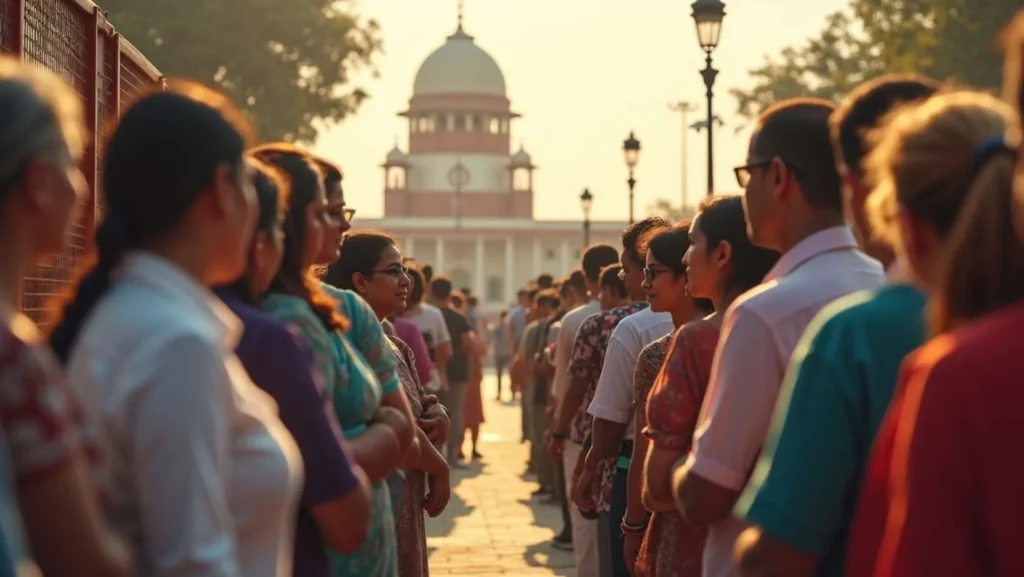
The most distinctive feature of Indian democracy is Adult Suffrage and this feature is characterized by the idea that all citizens, irrespective of their caste, creed, religion, gender, and economic status have an equal right to take part in the electoral process. When India followed this radical idea in 1950, it was to classify among the biggest democracies to grant voting rights to adults at once and to assert its declaration with regard to equality and democracy.
This historic ruling was the dream of our founding fathers who were of the opinion that only through incorporation of all voices into a single democracy would it be possible to have a thriving democracy. Universal adult franchise changed millions of Indians who were subjects to citizens, and gave them the basic right to influence the future of their nation through the ballot box.
What is the Universal Adult Franchise?
Universal adult franchise is a democratic ideal which is a right of all adult citizens to participate in elections regardless of their religion, race, caste, sex, and economic status. This entails in India that every citizen aged 18 years and above is allowed to elect their representative at different levels of the government.
This idea erases the historical obstacles such as property ownership, education levels or tax paying qualifications that once limited the right to vote. Political equality that is guaranteed by universal adult franchise means that democracy is really representative and inclusive as it acknowledges the dignity inherent to each citizen and the equal interest that he/she has in governance.
Franchise vs. Suffrage: Brief Etymology and Distinction
| Aspect | Franchise | Suffrage |
| Origin | French word “franc” meaning “free” | Latin word “suffragium” meaning “vote/support” |
| Common Usage | Broader term including voting and other civic rights | Specifically refers to the right to vote |
| Legal Context | Used in constitutional and legal documents | More common in historical and social contexts |
| Scope | Can include eligibility to contest elections | Primarily about casting votes |
| Modern Application | “Franchise” in Indian Constitution | “Women’s suffrage” in historical movements |
Historical Evolution
Before Independence
- Limited Franchise Under British Rule: Under colonial rule, citizenship was determined by the property ownership, taxpayers and educational levels in which a limited segment of the population was allowed to vote which left the greater majority of the Indians out of the political process.
- Communal Representation: the British also created individual electorates according to religion and community that further separated the Indian society and did not allow the development of a single democratic culture among masses.
- Government of India Act 1919: This act led to the introduction of limited franchise by offering voting rights to about 10 percent of the adult population that was mainly educated and property owning men, which disqualified the women and poor population.
- Government of India Act 1935: This Act had increased the electorate to approximately 35 million individuals which was approximately 14% of the adult population, yet continued to have property and educational requirements and qualifications that were discriminatory against ordinary citizens.
Freedom Movement and Debates
- Congress Demand of Universal Suffrage: The Indian National Congress had long supported Adult Suffrage since at least the 1920s, its political demands regarded it as the key to real self-rule, and it disregarded the British claim in India of its unreadiness.
- Nehru Committee Report 1928: It is a landmark report which clearly suggested universal adult suffrage without any property and any educational qualifications and made it a guiding principle in the democratic structure of independent India.
- Constituent Assembly Debates: There were heated debates about the literacy prerequisites and progressive introduction though visionaries such as Dr. B.R. Ambedkar and Jawaharlal Nehru strongly believed that it was time to have universal adult franchise as early as possible and without any rationing.
- Women Rights Movement: Women leaders, such as Sarojini Naidu and Hansa Mehta were resolute in the voting rights of women, so that they could be granted Adult Suffrage at the onset with no special terms.
Post-Independence Adoption
- Constitutional Assembly Decision 1949: Although the mass illiteracy was a cause of concern, the Constituent Assembly took the bold step of adopting the universal franchise of adult citizens, and the decision was evidence of the first ever belief in the wisdom and maturity of the Indian people.
- In 1952: India held its first general elections under universal adult franchise in 1951-52, and with a voter turnout of about 173 million eligible voters, it was the largest process in world history.
- Modification of Voting Age: The voting age was originally at 21 years but through the 61st Constitutional Amendment in 1988, the voting age was lowered to 18 years, and this increased the democratic participation by the youth.
- Incessant Growth: The number of voters has increased manifold over time, which started with 173 million in 1952 and now it is more than 900 million, making Indian democracy the largest and most active system of participation in the world.
Also Read: How to File a Case in Consumer Court in India
Constitutional and Legal Framework
Key Constitutional Articles
Article 326
The basis of universal adult franchise is laid down in article 326 of the Indian Constitution which states that elections to House of the people and the State Legislative Assemblies shall be on the basis of adult suffrage. All citizens of full eighteen years not disqualified by any law shall be entitled to vote in such elections.
In this article, there is political equality as a result of exclusion of discriminating factors such as property, tax, or education, that reflected voting rights in the past.
Article 324
Article 324 entrusts the superintendence, direction and control of all elections in the Election Commission of India and provides it with free and fair conduction of universal adult franchise. This is the constitutional organ with the powers to hold elections to the Parliament, State Legislatures, the position of President and Vice-President.
The article gives the Election Commission its independence and authority needed to uphold the integrity of the electoral process and safeguard the right of the citizens to vote.
Article 325
Article 325 also forbids the establishment of special electoral categories of individuals according to religion, race, caste, and sex, and strengthens the idea of universal adult franchise and equality. This is a provision that guarantees a common electoral process without any form of discriminatory segregation to all citizens.
The article is a promise of secular democracy and social cohesiveness in India which had outrightly denounced the system of communal representation that was a characteristic of the colonial era.
61st Constitutional Amendment
- Minority Voting Age: The amendment decreased the voting age by one year to 18 years; in 1988, which broadened the participation of the majority of youthful citizens in the democratic process in the millions of people.
- Youth Empowerment: It was realized that the youth were mature and aware, they had a right to be involved in policy making concerning their future and their growth.
- Political Awareness: With the objective of promoting political awareness among young people, more civic participation and responsibility at an earlier age in the democratic processes.
- Educational Effect: The shift was accompanied by the rise in the level of literacy and educational access indicating that young adults were more knowledgeable to carry out their franchise responsibilities.
- Global Alignment: Pulled India towards most democratic countries that acknowledged the age of 18 as a reasonable age of adult citizenship rights and responsibilities.
- Constitutional Process: The Articles 326 and the accompanying provisions are needed to be amended so as to prove the constitutional flexibility to suit the change of the social and democratic needs.
- Success of Implementation: The expansion was easily carried out in later elections and the youth voters emerged as an influential voting bloc in Indian elections.
In Democracy Why is Universal Adult Franchise Important
Core Democratic Values
- Political Equality: There is universal adult franchise whereby all citizens have equal political power and that one person has one vote irrespective of the social or economic status, thus making democracy really representative and just.
- Social Justice: It gives the marginalized groups of people such as women, scheduled castes, scheduled tribes, and economically weaker groups an equal role in the governance to enhance inclusivity and minimise historical discrimination.
- Legitimacy of Government: Governments are given legitimacy by the consent of the whole adult population so that the elected representatives truly represent the will and aspiration of all citizens.
- Accountability Mechanism: Universal adult franchise establishes effective accountability, by making government accountable to the needs of all the citizens, and not restricted to special interests so that a good governance will be achieved and the wellbeing of the people.
- National Integration: It promotes unity and sense of identity by providing equal voting rights to various communities in terms of religion, language and territories as Indian citizens sharing in mutual democratic activities.
- Empowerment Tool: Voting rights are the tools through which the citizens can demand development, justice, and rights and become not just passive subjects but active participants that can chart the course of their nation.
Implementation Mechanisms
Electoral Roll and Registration
The electoral roll or voters list is the official list of all the eligible voters in a constituency which is constantly updated to keep it accurate and inclusive. Registration is accessible and simple as every citizen over the age of 18 can register using Form 6, accompanied by identity and residence proofs.
The Election Commission regularly undertakes revisions and drives to include new voters and exclude dead or transferred persons to ensure that the lists are accurate. Online registration, Voter ID cards and photographs, and data databases have greatly enhanced the enrolment process and minimized fraudulent voting.
Election Commission’s Role
Election Commission of India is an autonomous constitutional body charged with the responsibility of ensuring free, fair and transparent elections throughout the country. It organizes electoral lists, publishes election dates, implements the Model Code of Conduct, and oversees that all political parties and candidates respect the election laws.
To protect the sanctity of universal adult franchise, the Commission may delay elections, override polls, and deal with infractions. It has sustained democracy participation and electoral integrity through programmes such as voter education, electronic voting machines, and voter-checking systems.
Global Perspectives / Comparisons
When India introduced Adult Suffrage in 1950, this was revolutionary since most of the developed countries had attained the same only after the gradual reforms. Some countries such as Switzerland also did not allow women to vote until 1971, whereas India had done this right after independence.
The mere size of Indian elections with a voting turnout of more than 900 million voters, spread across various geographical and societal settings, is unparalleled in the world. The Indian experience shows that a universal adult franchise can work even in the face of illiteracy and that democracy and development can work together and not in stages.
Contemporary Challenges
- Voter Apathy and Falling Turnout: Even with universal franchise, voter turnout has been worrying in some groups, especially urban centers where the majority of voters regularly turn in less than 50% , which signifies lack of interest of the voters in the electoral processes.
- Electoral Malpractices: Various areas such as booth capturing, buying of votes, giving of illegal inducements and intimidation of voters still affect the sanctity of universal adult franchise in most parts especially when it comes to local elections.
- Caste and Communal Polarization: Sometimes political parties take advantage of the social differences and identities and turn the Adult Suffrage into a system of mobilization based not on development concerns but on narrow caste or communal ones.
- Criminalization of Politics: The increasing numbers of candidates with Records running in elections casts doubt on the quality of representation as voters are presented with few real options despite having the right to vote universally.
- Digital Divide: The growing use of technology in voter registration, information sharing and electoral changes have set back economically poor and rural disadvantaged who have no digital access and literacy.
- Money Power and Influence: The unequal position of money in elections nullifies the notion of political equality present in universal adult franchise since affluent candidates and parties take control of elections and affect voters.
Case Laws and Judicial Insight
- N.P. Ponnuswami v. Returning Officer (1952): The Supreme Court made that right to vote was a statutory right, not a fundamental right, but Adult Suffrage is a constitutional principle, and made a distinction between franchise and its implementing mechanisms.
- Indira Nehru Gandhi v. Raj Narain (1975): It was a landmark ruling that exercised the principle of free and fair elections as an essential aspect of the basic structure of the Constitution, and the universal adult franchise forms the principle of democratic governance.
- PUCL v. Union of India (2013): The Supreme Court acknowledged the right to reject ( NOTA option ) candidates, reinforcing voter choice and making Adult Suffrage more substantial by permitting voters to indicate dissatisfaction.
- Election Commission of India vs. Ashok Kumar (2000): The Court confirmed the broad powers of the Election Commission to provide a fair and free election to guard the integrity of the Adult Suffrage against the malpractices and violations of the electoral process.
- Lily Thomas v. Union of India (2013): The ruling rendered guilty lawmakers ineligible as soon as they were found guilty, so as to make universal adult franchise become quality representation, not numerical turnout in the election.
- People’s Union for Civil Liberties versus. Union of India (2003): The Court ordered that criminal, financial and educational background of candidates be disclosed to enable voters to make wise decisions and enhance the power of Adult Suffrage.
Universal Adult Franchise and Social Empowerment
- Women in Politics: Universal adult franchise has made women become a decisive political power, and the number of voters, especially women, frequently surpasses that of males thus changing the picture of gender relations in Indian politics and government.
- Dalit and Tribal Empowerment: The historically marginalized communities have used the voting right to seek representative power, dignity, and development, which essentially upset the social order that existed since time immemorial and provided the marginalized groups with their constitutional rights via the democracies.
- Redistribution of Economy: Mandatory adult universal franchise forces governments to enact welfare states, subsidies and development programs to the poor and marginalized groups as they make up important voting blocks with electoral implications.
- Educational and Health benefits: Politicians are aware that educated and healthy people constitute conscious electorates, so universal suffrage would encourage investment in education and health, especially in low-denominated rural regions and in backward regions.
- Local Self-Governance: The universal adult franchise to Panchayati Raj institution has decentralized power and made governance more approachable to people and allowed the grassroot involvement in the planning and allocation of resources in development.
- Cultural and Social Movements: Voting rights have empowered other social justice movements by offering legal and political forums on which marginalized groups can voice their demands, bargain on their rights, and systematically challenge discriminatory practices.
Conclusion
Universal adult franchise is the most radical democratic experiment and the best story of successful experiment in India. India proved to be having an incredible trust in the common sense and judgment of its people by giving equal voting rights to all adult citizens as early as independence as it is widely known that in India majority of the citizens are poor and illiterate. The principle has made millions of marginalized people become empowered citizens with unparalleled social mobility and political participation.
The Adult Suffrage in India still continues to develop with a response to the present day problems by integrating technology, judicial interventions, and institutional reforms. With India having a population of more than 900 million voters, the dedication of this basic democratic principle has not diminished. The Adult Suffrage does not only guarantee political equality, but also leads to social change, thus, allowing democracy to be really of the people, by the people, and to the people in the largest democratic system in the world.
FAQs
What is the voting age in India on universal adult franchise?
In India, the minimum age to vote is 18 years and this was lowered by the 61 st Constitutional Amendment Act of 1988 to 21 years of age, and now young adults are eligible to vote.
Is it not possible to deny to every Indian citizen his right to vote in Adult Suffrage?
Yes, citizens may be disqualified, on the ground that they are of unsound mind, pronounced so by a competent court, or have committed some offence, but such are exceptions to the usual rule.
What is the Constitutional article that provides universal franchise to adults in India?
The Indian constitution art. 326 provides Adult Suffrage in which elections should be instituted in terms of adult suffrage and all citizens who are 18 and above years should have a right to vote.
How is the universal adult franchise in India in comparison with the rest of the world?
India was a progressive democracy as it instituted Adult Suffrage to all its citizens including women as soon as it became independent in 1950, long before most of the developed world, and this was an evolutionary move in democracy.
What is the role of the Election Commission in practicing universal adult franchise?
The Election Commission of India which operates under Article 324 is in charge of free and fair election through the management of electoral roll, election rules and safeguard of the right to vote of citizens in the country.