


Divorce in India may seem like a heavy burden, more so when you are under emotional strain and you are not sure of your future. That being said, whether you are thinking of separation or are already in the midst of a court battle, it is important to know how a divorce operates in India in order to make informed choices. The legal environment in India is very varied, with various laws governing various people, and the procedures are also different depending on the mutual consent and the disputed divorce.
It is a detailed guide that simplifies the divorce process in India into easy, digestible steps, including all the procedures in terms of legal basis and documents, as well as time frames and entitlement. We are going to make this difficult period clear and confident in your eyes.
Why Understanding the Divorce Process is Important
- Legal Protection: Educating yourself about your rights will make sure that you are not exploited in the process and will enable you demand what you are legally required to obtain.
- Emotional Preparedness: Mentally knowing what is coming ahead will prepare you for the process, reduce anxiety, and make you more adaptive to changes.
- Time and Money Saved: Knowledge will keep you out of expensive errors, time wasting, and will enable you to select the correct legal strategy initially.
- Child Welfare: Custody legislation makes you conscious of maximizing the best interests of your children and entering into an agreement that favors them the most.
- Fair Settlement: With knowledge of financial rights, you can bargain on alimony, property distribution, and maintenance, assuming a position of strong bargaining knowledge.
- Best Solution: The awareness of the various types of divorce will assist you in deciding the most suitable path that takes the shortest time, either the mutual consent or the contested divorce process.
Which Laws Govern Divorce in India?
Hindu Divorce
Divorce among Hindus, Buddhists, Jains, and Sikhs in India is governed by the Hindu Marriage Act of 1955. This law gives certain reasons for divorce, such as adultery, cruelty, desertion, conversion, mental disorder, and irretrievable breakdown of marriage. Hindus are under a divorce process in India that involves mutual consent as per Section 13B, or that it is proven under Section 13.
Muslim Divorce
Muslim marriages in India are governed by the personal Muslim law, like the Dissolution of Muslim Marriages Act, 1939. Muslims have the option to obtain divorce by Talaq, Khula (divorce of the wife), or mutual consent (Mubarat). This way of doing things is very different in comparison to other societies, while even such things as Triple Talaq are made illegal, and the proceedings are handled according to the Islamic principles.
Divorce for Christians & Parsis
Christians adhere to the Indian Divorce Act, 1869, which demands proof of matrimonial offenses such as adultery, cruelty, or desertion for at least two years. The Parsis are provided with the Parsi Marriage and Divorce Act of 1936 that gives them similar grounds as reasons that led to divorce. Mutual consent divorce is also an option that both communities can look to, and therefore, divorce in India is simplified when both are in agreement.
Divorce Petition by Wife – How It Works
Females in India have the same right to divorce and could start the process without seeking the consent of their husbands. The wife has freedom of jurisdiction because she can petition the family court where she is staying, place the marriage, or the last place the couple cohabited. The divorce process in India also enables wives to demand divorce on any of the following grounds: cruelty (physical or mental), adultery, desertion, impotency, or irretrievable breakdown of marriage.
The petition should include the reasons why the divorce is required, with supporting evidence, and the wife should provide supporting documents such as the marriage certificate, residence proof, and support of the grounds alleged. Upon filing, summons are given by the court to the husband, and in case of contest, the lawyers present the case on behalf of both parties. During the proceedings, the wife may demand interim maintenance to sustain her until the final judgment. Section 498A IPC, which safeguards against cruelty and dowry harassment, also protects women and makes them more powerful in divorce cases.
Rights of a Woman in Divorce in India
Financial Rights
Under the 125 CrPC, the Hindu Marriage Act, or any other personal law under which women fall, they can claim maintenance (alimony). This depends on the income of the husband, the needs of the wife, and also on the earning capacity of the spouse. Maintenance in the proceeding and post-divorce period is interim as well as permanent, which secures financial security.
Child Custody & Support
Children who are below seven years are usually left with the mother, and the court mainly holds the best interest of the child first. Child support and maintenance can be adopted by the wife, whether there is custody sharing or not. The non-custodial parent is granted the right to visit the child, which is a balance between the parental participation in the life of a child.
Property Rights
Women can have the right to property that is gained together in marriage, and under certain situations, contributions can make a claim. Stridhan (gifts, jewelry that was received before, during, and after marriage) is the prerogative of the wife and has to be given back. Ancestral property can also be shared by Hindu women, giving them a stronger economic standing after the divorce.
Types of Divorce in India
| Type of Divorce | Brief Description | Applicable Law |
|---|---|---|
| Mutual Consent Divorce | Both spouses agree to end the marriage. | Hindu Marriage Act, Special Marriage Act |
| Contested Divorce | One spouse files on legal grounds (cruelty, adultery, desertion, etc.). | Hindu Marriage Act, Special Marriage Act |
| Muslim Divorce | Talaq, Khula, Mubarat, etc. | Muslim Personal Law |
| Christian Divorce | Divorce on specific legal grounds. | Indian Divorce Act, 1869 |
| Parsi Divorce | Divorce on grounds like cruelty or adultery. | Parsi Marriage & Divorce Act, 1936 |
Mutual Consent Divorce
The quickest and the most friendly route in which the two spouses consent to divorce and the terms of the same, such as alimony, custody, and property sharing. Section 13B stipulates that the couples should have been separated for at least one year, submit a joint petition, and attend two motions, subject to a cooling-off period of six months. This is a fast-tracked divorce procedure in India that normally takes between 6 and 18 months.
Contested Divorce (Fault-based)
In the case of divorce by one spouse and the other opposing it, or when evidence and witnesses have to be presented in court to prove the grounds. Some of the common reasons are cruelty, adultery, desertion, or mental illness, which need to be proved significantly. It is a long, emotional process that may require 2-5 years or even longer, according to the complexity of a case.
Quick Divorce Process in India
The recent judicial reforms permit the courts to skip the required six-month waiting period in mutual consentcase ss in case they are convinced that reconciliation cannot be achieved. In certain high courts, divorce is granted as a one-sitting case as all conditions are agreed upon, and both parties are willing to consent to the case. In positive situations, this quick divorce method in India can be completed in 3-6 months.
Step-By-Step Divorce Process in India 2026 (General)
Step 1: Filing the Divorce Petition
Either of the two spouses (the petitioner) files the divorce petition in the relevant family court that has jurisdiction over the case.
- The court has to have a jurisdiction, either in terms of residence, or place of marriage, or last cohabitation.
- In the petition, information on marriage, reasons for divorce, and relief requested by the petitioner is included.
- The documents required are a marriage certificate, address proof, photographs, and any evidence to support the grounds of divorce.
- Payment of court fees is dependent on regulations and the amounts of relief that are claimed by the state.
- The lawyer assists and prepares the petition correctly with all the legal necessities and formalities being correctly arranged.
Step 2: Serving Notice to Respondent
Upon filing, summons are issued to the other spouse (respondent) by the court notifying them that there is a divorce is taking place.
- Delivered by registered post, court process server, or personal service, to provide that delivery.
- A petition is sent to the respondent, who is given 30 days to respond in writing.
- In case the respondent is not found, the court may direct that notice be published in newspapers.
- Evidence to prove service should be provided in court to continue with the case.
- Respondents have the option of challenging the divorce or accepting the terms put forward.
Step 3: Response from Respondent
The respondent submits a written submission to either accept the petition or deny the allegations and grounds.
- When uncontested or mutual, then both parties accept the terms, and proceedings proceed more quickly.
- In case of disagreement, the respondent refutes accusations and offers counterclaims or defenses to divorce.
- Respondents can counter-petition seeking a divorce on other grounds or object to the claims of the petitioner.
- Evidence, documents, and witness lists are shared between the two parties.
- The court establishes the evidence filing date and hearings to handle the case effectively.
Step 4: First Motion Hearing (for Mutual Consent)
Mutual consent divorce involves all the spouses appearing together before the court in the initial hearing of the first motion.
- The judge confirms that the consent by the parties is free, voluntary, and not coerced or pressured.
- Both sides of the case attest to the court record that they want to amicably divorce.
- The court presents and reviews the settlement terms of alimony, custody, and property division.
- The court orders a six-month period of cooling off to re-examine and reconcile between the parties.
- First motion is noted, and second motion is adjourned on the case after the required waiting period.
Step 5: Evidence & Trial (for Contested Cases)
During a contested divorce, the two parties are heard, give evidence, cross-examine witnesses, and put their case before the court.
- Petitioner offers evidence in the initial stage, with documents, witness statements, and expert opinions in support of claims.
- Respondent cross-examines the witnesses of the petitioner in order to discredit and undermine the strength of his case.
- Defense evidence and witnesses are then produced by the respondent in their defense.
- Cross-examination of witnesses by the petitioner: This is to test the veracity and consistency of the testimonies of the respondent witnesses.
- Even at trial, the court may appoint mediators or counselors to try to reconcile.
Step 6: Arguments & Submissions
Once the evidence has been presented, both parties have lawyers who make the final arguments to summarize their cases in a nutshell.
- The attorney of the Petitioner reasons why divorce is needed on the evidence and legal basis.
- Instead, the lawyer of the respondent advances counter-arguments to defend against divorce or advance counter-claims.
- Both parties give applicable case laws, precedents, and legal provisions to back their arguments.
- The court can pose questions to get clarification of facts, evidence, or legal interpretations brought up.
- A memo can be written with the major arguments and legal standpoints summarized to be used by the court.
Step 7: Second Motion (for Mutual Consent)
Mutual consent cases require a cooling-off period of six months, after which all parties attend a second motion hearing at once.
- Both parties agree that they still desire to get a divorce, and they have not reconciled within the waiting period.
- The court confirms that settlement terms are being met and coercion has not taken place in the meantime.
- In case of a change of mind either way, the petition will be dismissed, and the marriage will proceed as legal.
- Divorce is passed on court when there is a re-consent and the settlement is equitable between both parties.
- The decree would come into action, and the marriage would be legally dissolved from that date.
Step 8: Court Judgment
The judge in the case studies reviews all the evidence, testimonies, and arguments and gives a final verdict in the contested case.
- The court assesses the essence of the ground reasonableness of divorce proven beyond a reasonable doubt.
- The judge takes into consideration the conduct, credibility, and quality of evidence by both parties to arrive at the decision.
- The divorce grant and denial, alimony, custody, and property division are all handled through judgment.
- Written order is prepared in detail, stating reasons, findings, and the legal basis of the decision.
- The court can allow or disallow divorce depending on the merits, evidence, and law.
Step 9: Decree of Divorce
After judgment is done favorably, the court passes the formal decree of divorce document, which legally ends the marriage.
- The decree has divorce terms such as financial settlement, custody, and other terms.
- Both parties are given certified copies of the decree to keep in their records.
- This is evidence of a legal divorce that is necessary during remarriage or official occasions in any place.
- The terms of the decree, such as the payment schedule and custody, have to be adhered to by both parties.
- Enforcement of the decree may be done by use of the court where either party does not keep the agreed terms.
Step 10: Appeal (if applicable)
In case one of the parties feels that the ruling is unfair, he or she can take it to the courts of higher authorities.
- The appeal has to be brought within stipulated time limits in the case, usually 90 days after judgment.
- The appellate court will examine the decision, evidence, and application of the law of the trial court to either identify some mistake or unfairness.
- The lower court may revise or totally overturn the divorce decree of the higher court.
- The appeal process prolongs the process for a long time, which may be 1-3 years, to the entire divorce process in India.
- Final appellate decision is binding except in cases where additional appeals to the Supreme Court are made and admitted.
Minimum Separation Period for Divorce in India
In the divorce process in India, couples seeking a mutual consent divorce must be separated for at least one year prior to submitting their petition, a requirement under Section 13B of the Hindu Marriage Act, and the same in other personal laws. This cooling-off time also gives the couples a chance to change their minds and make an effort to reconcile their marriage till it is too late.
Also, once the initial motion is filed, one must wait a six-month period before the second motion is filed, but the courts may be excused in extraordinary situations. In contested divorces on fault grounds, no minimum separation period is required, but the proving grounds, such as desertion, normally require evidence of at least two years of abandonment. The time of separation shows how marriage is irreversibly broken down and makes divorces not given on the spur of the moment when there are temporary differences.
Divorce Process in India for Muslims
- Talaq: Husband utters Talaq (divorce) according to the correct Islamic practices; Triple Talaq during a single sitting is now a criminal offense and null under the Muslim Women Protection Act, 2019.
- Khula: Divorce initiated by the wife when she demands an exit out of marriage, which is normally by repaying the Mehr (dower) or entering into a financial agreement with the husband.
- Mubarat: The agreement in divorce where both spouses mutually decide to divorce by mutual understanding, as is the case in other laws.
- Judicial Divorce: Muslim women may go to court based on the Dissolution of Muslim Marriages Act, 1939, on the basis of cruelty, desertion, impotency, or lack of maintenance by the husband.
- Mehr Payment: According to the terms of the marriage contract, the husband has to give the agreed Mehr to the wife in case of divorce.
- Iddat Period: A wife should observe Iddat (waiting for three menstrual cycles or three months) before she remarries after divorce.
- Documentation: Divorce deed (Talaqnama): This has to be signed and registered; a court decree is needed in case of divorce that is not extrajudicial but judicial.
Divorce Papers & Documentation Required
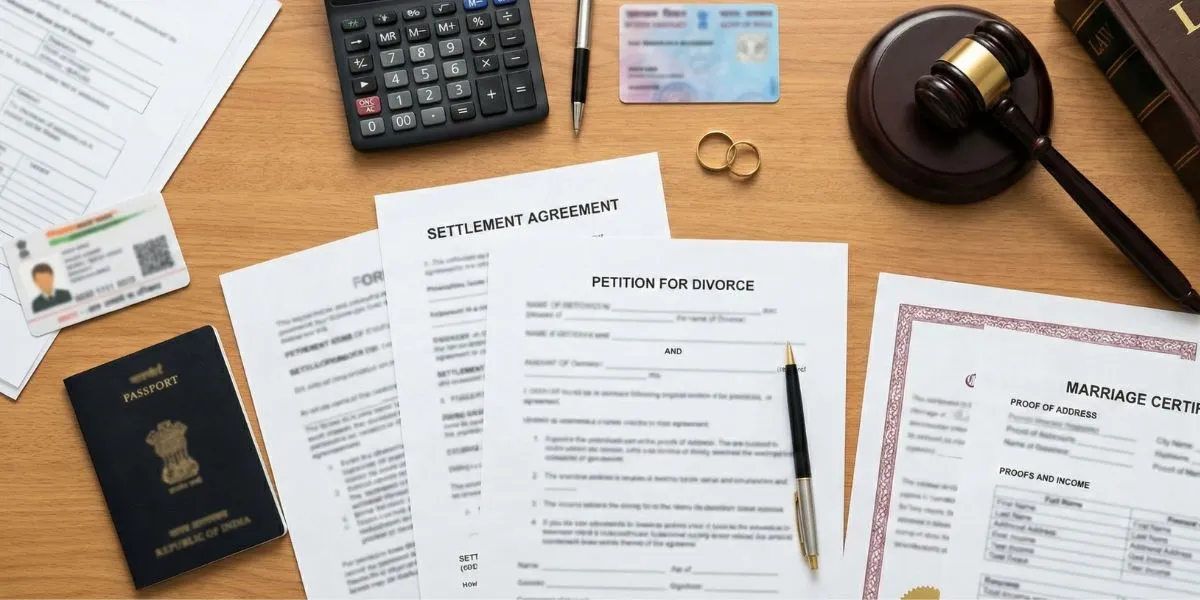
- Marriage Certificate: Original or certified copy of the marriage registration certificate of the legal marriage between the parties.
- Petition for Divorce: Well-drafted divorce petition in terms of grounds, facts, and relief required, signed by the petitioner and counsel.
- Address Proof: Residence evidence of the parties, such asan Aadhaar card, voter ID, passport, or rental agreement to prove jurisdiction.
- Already prepared identity documents: PAN card, Aadhaar card, passport, and photographs of both spouses to identify and verify them in case of any inconvenience.
- Proof of Income: Bank statements, tax returns that show financial position to establish the amount of alimony and maintenance.
- Grounds Evidence: Records of medical certification of cruelty, adultery evidence, desertion, and communications.
- Settlement Agreement: In mutual consent cases, the written agreement gives details of alimony, child custody, property division, and other settlements.
How Long Does It Take to Get a Divorce in India?
Divorce procedure in India takes a very long time, depending on the nature of the divorce and the efficiency of the courts. The quickest path is a mutual consent divorce that will usually require 6-18 months with the mandatory six-month cooling-off period between first and second motions, but courts are now waiving the cooling-off time, and are disposing of cases in 3-6 months.
Contested divorces are quite protracted and generally take 2-5 years or longer to complete, depending on the complexity of the case, volume of evidence, availability of witnesses, as well as court backlogs. In certain states, the fast-track courts have been known to handle their cases faster, and in others, the cases have been characterized by a lot of time losses due to the high number of cases. Another 1-3 years at every level of appellate can be added to the process. All in all, the divorce process in India is time-consuming, and employing an experienced lawyer would assist in speeding up the process by managing the case effectively.
How a Divorce Lawyer Can Help
- Legal Expertise: Advice on the law to apply, divorce-based reasons, rights, and optimal legal approach to your case.
- Documentation: Prepares and submits all the required petitions, applications, and documents correctly and adheres to the procedural requirements.
- Court Representation: Fights on your behalf in every hearing session, makes a good case, and conducts litigation in a professional manner.
- Negotiation Skills: Negotiates the best settlement terms in terms of alimony, child custody, property division, and keeping your own interests and rights safe.
- Evidence Management: Assists in collecting, arranging, and delivering evidence in a way that makes your case stronger and makes the grounds convincing.
- Emotional Buffer: Forms of professional middle ground between spouses, less emotional stress in hard proceedings.
- Time-Saving: Deals with legal complications so that you can concentrate on other important aspects of personal well-being and restructuring life during stressful periods.
- Appeals Handling: In case of necessity, files and appeals in superior courts to appeal against adverse decisions and demand justice.
Practical Tips to Navigate Divorce Smoothly
- Early Consult Lawyer: Consult a lawyer early on before making big decisions in order to be in a position to know your rights, options, and possible consequences.
- Gather Documentation: Begin to assemble marriage certificates, financial records, property papers, and other evidence supporting your grounds in order to file them.
- Keep a Cool Head: Be calm and rational throughout the hearing; emotional eruptions are not beneficial in the eyes of the court and may hurt the case results.
- Put Kids First: This will act in the best interests of children in custody proceedings; decision-making should not be based on personal feuds but rather on the children.
- Think of Mediation: As an alternative to litigating against each other in court, use time, money, and emotional effort to mediate or have a counseling session to resolve the dispute amicably.
- Record Notes: Prepare notes of all communications, financial, and engage in interaction with the spouse,e in case they are needed as evidence.
- Financial Planning: Evaluate your financial position after the divorce early, budget, and plan on how to live independently and meet your future needs.
- Avoid Social Media: Do not share information on social media about divorce or your spouse; this will be used against you.
- Be Honest: Be honest with your lawyer and court because any dishonesty may have a serious negative effect on your credibility and the strength of your job.
- Take Care of Yourself: This is a difficult transition period to focus on mental and physical health through counseling, exercise, and support systems.
Conclusion
The divorce process in India is a legal process that needs to be carefully navigated with patience and understanding of the rights to this process and the requirements of the law in relation to this. And whether you are seeking a mutual consent divorce so as to have an amicable separation or a contested divorce where there is no possibility of reconcilable differenwell-informedormed will enable you to make more effective decisions to defend your interests.
Knowledge is your best friend in this difficult period, as it is the difference between knowing what laws to follow in your divorce and the step-by-step procedure, the paperwork, and what you are entitled to in terms of finances, custody, and property. Although divorce may be a taxing experience in India, particularly when it is a contested situation, bear in mind that it is a way to new horizons and self-development. With the assistance of correct law, emotional strength, and attention to practical issues, it is possible to go through this process easily and come out as a person who is not afraid and has hope for a better future.
FAQs
In India, can I divorce without the consent of my spouse?
Yes, you may apply on the grounds of fault, such as cruelty, adultery, and desertion, even without the consent of your spouse, though it is a long process that involves proving to the court.
What is the cost of divorce in India?
Mutual consent divorce is 15,000-50,000 with lawyer fees and court fees, and contested divorce costs 50,000-5,00,000 and above, depending on the complexity and time.
Is it possible to eliminate the six-month waiting period?
Yes, the court may dispense with the six-month cooling-off period requirement in situations of mutual consent when it is persuaded that reconciliation cannot take place, and both litigants wish to be divorced.
What becomes of the property in a divorce?
The division of property is based on ownership, where jointly owned property is divided according to contribution and court discretion, though individual property is retained by its owner unless stated to the contrary in the settlement.
Is it possible to remarry right after the divorce decree?
Yes, one can remarry as soon as the divorce is issued, with the exception that Muslim women have to observe the Iddat period before remarriage according to the Islamic law provisions.