


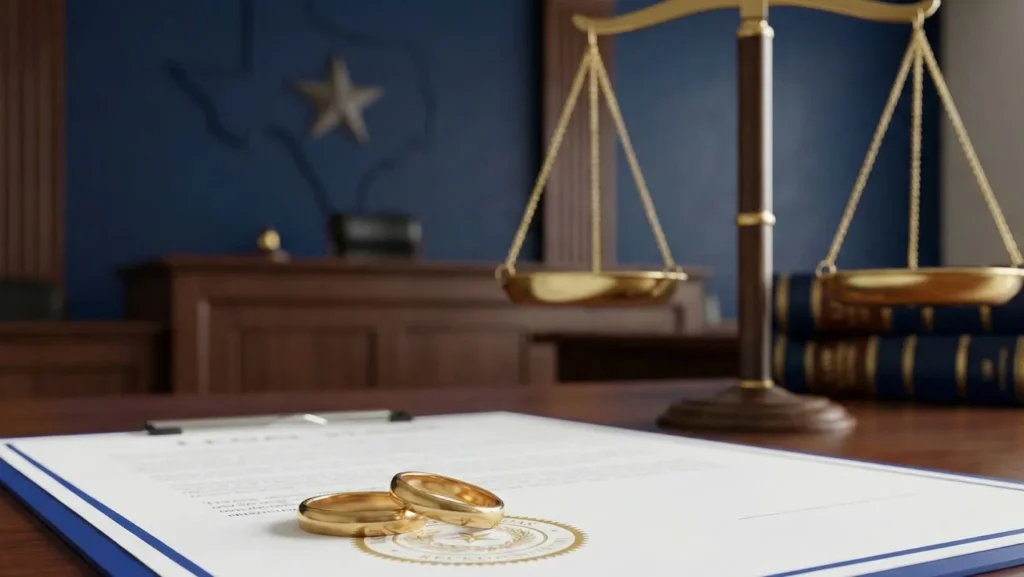
The common law marriage exists, and couples entering into marriage can legally be married without a wedding. Texas and a handful of other states are among the last few states in which this kind of marriage is recognized in 2026; the couples should be aware of how such marriages operate and how they may be ended. Some individuals believe that one should wait a period of time, say, 7 years, 5 years, or even 6 months, before one can be regarded as a married person under the common law, and this is not the case.
The Informal law of marriage in Texas is found in Texas Family Code, Section 2.401, and the same rules have not altered much despite the changed families. In Texas, which has thousands of people annually having their common law marriages legalized through declarations by the county clerks, thousands more couples live in a known relationship without ever having to complete any legal documentation related to common law marriage in Texas.
The knowledge of laws is particularly relevant in cases when a marriage is terminated or when people inherit property. Many cases brought before Texas courts in 2026 query whether or not a common law marriage was in existence, especially when people part but fail to divorce. The State of Texas gives a time limit of two years in which a common law marriage texas can be established after the separation, and the deadline can also influence the division of property and those who receive the rights to legal services.
TL;DR – Common Law Marriage in Texas (2026)
- Yes, Texas still recognizes common law marriage under Texas Family Code Section 2.401.
- No 6-month or 7-year rule. There is no minimum time requirement to be considered married.
- A valid common law marriage requires three things at the same time:
- Agreement to be married
- Living together in Texas
- Holding yourselves out as married
- It gives the same legal rights as a formal marriage (property, inheritance, spousal support).
- You must file for divorce to end it — separation alone is not enough.
- There’s a 2-year deadline after separation to prove the marriage in court.
What Is Common Law Marriage in Texas?

Regardless of whether you are already cohabiting or considering cohabiting under the common law, knowledge of the legal principles can assist you in making good decisions regarding your relationship status.
The common law marriage, Texas, or informal marriage is a legal wedding, though there is neither a ceremony nor a license. According to the law of Texas, when a couple unites, three conditionsare simultaneously met: they consent to marriage, live together as a family, and consider themselves married people in the eyes of others.
These marriages are treated like the wedding marriages by the Texas family code. This implies that they possess equal property, inheritance, and benefits rights. As a result of the Obergefell v. same-sex marriage case of 2026, both same-sex and opposite-sex couples will be able to marry under common law. Hodges in 2015.
How Long Do You Have to Live Together in Texas for Common Law Marriage?
In contrast to the relationship, or simple cohabitation, real legal obligations are brought about by a common law marriage. The minimum age of the couples should be 18 years old, not be married to another person, and it should not be of close relations. After the marriage is in place, it does not terminate itself; it needs a divorce just as much as a normal marriage.
The law has indicated that a couple is allowed to reside together without a minimum time before it can initiate a common law marriage in Texas. The idea that they have to stay together for 7 years, 5 years, or any rigid duration is a delusion. The Texas laws do not point to any time requirement to make an informal marriage in the year 2026.
The three things, namely being in agreement, cohabitationg and demonstrating to others they are married, are what are present at the same time. Theoretically, a couple can enter a common law marriage after a few weeks or days, provided that they comply with all the regulations. It is in addition to the nature of the relationship and not the length of the relationship.
Do You Need to Be Together for a Specific Time? (6-Month Rule Explained)
The courts consider the case on a case-by-case basis, where facts and evidence are taken into consideration. Extended relationships can assist in demonstrating the three required elements; however, length can never make a common law marriage in Texas. According to the Texas law, couples who spend decades together without having to marry or pose as married will not be regarded as legally married.
The myth about marriage law in Texas is the so-called 6-month rule. The law of Texas or judicial decision did not establish any 6-month, 1-year, or year requirement on an informal marriage. This confusion can either be the source of other rules or sources of rules.
Texas courts continue to decline time requirements in ruling on claims of common law marriage in 2026. The Texas Family Code of Section 2.401 states nothing with regard to time periods; it is merely inquisitive that the three main elements be met simultaneously, whether it be during a few days or during several years.
Requirements for a Common Law Marriage in Texas

Agreement to Be Married
One timely provision exists, which is the two-year statute of limitations for establishing a common law marriage once the couple has split. In case they do not file any in court in time equivalent to more than two years, Texas then assumes that there was no marriage at all. This assumption may still be overcome by strong evidence, and it is quite difficult to prove after two years.
The initial necessary requirement is that both individuals should have an immediate and permanent consensus to get married. They must be determined to establish a marital relationship present and not in the future. The promise to marry later in Texas in 2026 does not suffice for this requirement.
The contract does not necessarily have to be formal or written. A couple of actions, words, and conduct can be the basis on which the courts can infer it. Both spouses are to be genuinely willing to get married. This may be in the form of verbal promises, social media, or even what they themselves say. The contractual agreement should demonstrate that they are getting into a marital relationship, not a committed partnership.
Living Together as Spouses
In Texas, cohabitation is the process in which two couples live together as spouses. This is the simplest aspect that one can prove, usually by presenting a lease, utility bills, or mail directed to each of the names at the same address. By 2026, it will merely imply cohabiting within the state of Texas.
The setup should depict a marriage relationship, and not simple roommates. Judges test whether the couple behaves as a family; they share the rooms, money, and daily life. This is not prevented by short separations that are occasioned by work, military, or temporary reasons, provided that the home is maintained.
In Texas, even when they have complied with the other two rules, the couples are not allowed to establish a common law marriage in Texas when they do not live together. They cannot live outside of Texas, and they have no choice but to live together after being married to one another.
Holding Out to the Public as Married
The third one is that the couple should display their married status to others. It is a regulation that prevents secret marriages, and it ensures that individuals regard them as spouses. This is still taken to be important evidence of marriage intention, as indicated by Texas judges as of 2026.
Indications of holding out may involve the introduction of each other as spouses, wearing wedding rings, use of similar last names, filing joint tax returns, noting the other as spouse on insurance or credit card applications, or telling friends, families, and colleagues that they are married.
This should be announced openly and regularly by the couple; however, there is no need to announce a lot. The judges will examine all the facts and ask themselves whether a regular individual would view them as married. A comment being out-of-place is not always sufficient; they need to demonstrate a tendency towards exhibiting that they are married.
Declaration of Common Law Marriage in Texas (Affidavit)
Under the Texas law, couples have an opportunity to document their common-law marriage by declaring a Declaration of Informal Marriage at the county clerk. This type (VS 180.1) is a legal testimony to marriage without ceremony. This continues to be the simplest method of writing up a common law marriage in Texas in 2026.
The two individuals have to both sign the form before the county clerk, who then registers it in the marriage records. The form indicates that the couple satisfies all three requirements, namely, agreement, cohabitation, and holding out. After filing, the form turns out to be hard evidence of the marriage in legal aspects such as property, inheritance, and spousal provisions.
The filing fee is minimal, but depending on the county, it is usually $25 to 100 in 2026. It is not very difficult and only requires a single visit to the office of the county clerk. Both have to demonstrate ID and cannot be married to another person. This is optional, but it assists in eliminating conflicts in the future regarding the status of the marriage and making it easy to establish the marriage when it comes to insurance, taxes, and estate planning.
Legal Rights & Benefits of Common Law Spouses in Texas
The common law marriage in Texas provides the spouses with an equivalent number of rights and responsibilities as a formalized marriage. According to Section 2.401 of the Texas Family Code, once it is proven, it cannot be viewed as lower than a ceremonial marriage. This equality extends to property rights, inheritance, and spouse benefits in 2026.
- Property Division: Community property should be equally divided during a divorce, even though the property is in the name of one partner, despite his or her name being in the record.
- Inheritance Rights: A common-law spouse is allowed to inherit his or her partner in case his or her partner dies without a will, the same way a spouse in a marriage under Texas probate law.
- Healthcare Decisions: The common-law spouses are allowed to make medical decisions on behalf of one another and possess equal rights of visiting each other in hospitals as their formal spouse.
- Tax Benefits: Married couples are legally dependent and can be jointly taxed on federal and state taxes, which will reduce their overall taxes.
- Insurance Coverage: The common-law spouses may become a part of the insurance as a family health insurance and be listed as a beneficiary of life insurance in the case of formal spouses.
What Is a Common Law Spouse Entitled To in Texas?
In Texas, the legal rights accorded to a common-law spouse are the same as those of any married individual. There is no consideration in terms of entitlements as to whether the marriage was established informally or not. In 2026, the Texas courts continue to treat them equally, irrespective of the manner of commencement of marriage.
- Property: According to common law marriage in Texas, all community property acquired throughout the union is the community property; houses, cars, bank accounts, retirement benefits, and other properties purchased after the marriage, among others. In a divorce, this property is divided fairly according to the court.
- Spousal Maintenance: Spousal alimony is available to spouses under common-law upon separation of a marital union. According to the Texas Family Code, the supporting spouse might be compelled to pay temporary or long-term support depending on the length of marriage, money disparity, and other factors. Common-law spouses even have the option of seeking a temporary order of support and use of property during a divorce, as formally married couples do.
Separation & Ending a Common Law Marriage

A common-law marriage in Texas can be ended just as is the case with a ceremonial divorce. The issue of separation/moving out alone does not end the marital union. In 2026, to legally terminate the relationship and apportion property, the couple members of a common-law marriage have to submit a petition for divorce to the relevant court.
Among the key guidelines used by divorced couples is that, according to Texas law, an existing rebuttable presumption already gives that no marribeenhad they overlookis not fwas not filed filed a suit within two years after the relationship ended. Once this period of 2 years elapses, the marriage is given the benefit of a significant hardship, but by showing strong evidence, it is possible. This period is enforced to ensure that claims are not stale.
How the process of divorce works in a common-law marriage in Texas is the same as any other divorce. Community property is divided, children must be provided with child support or orphanage, and spousal maintenance can be given by the courts. In the case of separation between two people without having married them legally by a declaration, then first they need to establish the existence of marriage, and after that, divorce. This frequently calls on the production of evidence of consensus, cohabitation, and holding out during the preliminary hearings or summary judgment motions.
How to Prove a Common Law Marriage in Court
In order to establish a common law marriage in Texas, court cases must provide clear and credible evidence that all three statutory elements existed at the same time. These are courted in the Texas courts on a case-by-case basis, and the facts and circumstances of each relationship are considered. Here, in 2026, some 15-20% marriage cases in family law entail the argument whether a common-law marriage had occurred.
- Joint financial records: tax filings as married, joint bank accounts, joint credit card usage, and joint loans have been proven as financial entwining and marital purposes, which is characteristic of married partners.
- Witness accounts: friends, relatives, colleagues, or neighbors can be interviewed about their introduction of the couple, and how they socially and professionally identified themselves as a married couple.
- Written communications: Emails, SMS, social media, and letters where parties discuss and address one another as spouses are all examples of present-day evidence of holding out and agreement.
- Documentary evidence: insurance policies containing a partner as spouse, beneficiary designation, medical record indicating next of kin status, and lease agreements can be used to prove cohabitation and represent it publicly.
- Evidence of personal behaviour: the presence of wedding rings, interchangeable last names, as well as family photographs, in addition to joint membership and celebration of anniversaries, evidence the existence of living with a married case.
Common Misconceptions (e.g., 6-Month Myth)
There are a lot of misconceptions about common law marriage in Texas that can be taken into wrong consideration by many Texans. These legends continue even when the law is known explicitly and has been ruled on a case-by-case basis. According to family law lawyers, in 2026, about 60 or more cases of first consultations will imply the client who fail to understand the way in which informal marriages will be arranged.
- Myth of Seven-Year Cohabitation: There is no period of stay in the Texas law that the partnerships marry after living together seven years, five years, or any other length without all three elements that constitute marriage.
- Marriage by Automatic through children: getting children together does not constitute a common-law marriage; the parties have to be willing to marry, live, and represent themselves as a married pair.
- Common Law Divorce Myth: Separation does not necessarily terminate a common-law marriage; two people should obtain an official divorce just as ceremonially married ones, in order to legally break up the union.
- Secret Marriage Possibility: The holding out rule prohibits secret marriages, so the common law marriage couples may not marry secretly before other people have been given the impression of their representation as such.
- Engagement is Marriage: The requirement of having an agreement can not be fulfilled with being engaged or with future marriage intentions; the parties need to possess present, immediate marital intent.
Conclusion
It is very important to be familiar with the marriage laws of common law marriage in Texas to stay in the right direction as a couple, or do not get into situations leading to unintentional issues. The three-part test, which includes agreement to be married, cohabitation, and holding out to the public, should be fulfilled together, and the minimum time requirement will not be specified. By 2026, Texas still consider these marriages to be fully valid and will have the same rights and protections tasceremonial marriages.
Anyone who has been, or is planning to get married under informal marriage in Texas or elsewhere that applies the common law, it would be best to consult with a competent family law attorney. Such relations are of considerable legal impact that influences property, debts, benefits, and obligations. Knowing your rights and duties in Texas law is a way to make sure that you make correct decisions regarding your relationship status and protect your interests in case of the relationship termination.
Also read:
FAQs
How long do you have to be together for common law marriage in Texas?
No particular time is necessary. In Texas, common-law marriage is pegged on the fulfillment of three requirements, including agreement to marry, cohabitation, and holding out as opposed to the length of the union.
Can you accidentally enter a Texas informal marriage?
It’s unlikely. You have to consent to marriedness in order to live together and present yourself as married. Living together does not make one a marital union.
Do common law spouses get half of everything in Texas?
Yes, if it is a common law marriage. Texas does not distinguish between community property, and its property is split just like in the case of the ceremonial marriages in divorce.
How do you end a common law marriage in Texas?
You have to get a divorce in court. A common-law marriage in Texas cannot be physically separated to be dissolved; an official legal procedure has to terminate it.
Does Texas still recognize common law marriage in 2026?
Yes. Texas is also among the limited states that acknowledge common law marriage, and the provisions have been presented in Section 2.401 of the Family Code.