


There has been an increased consumer protection in India in the last few years. In case you have purchased a defective product, overcharged, noticed fraudulent business practices and so on, you can get an idea of how to file a case in consumer court and receive justice without protracted legal proceedings.
In India, the consumer court operates under Consumer Protection Act of 2019 that replaced the previous Consumer Protection Act of 1986 to ensure that redress is quick and easy. Over 680 district consumer commissions, 35 state commissions and 1 national commission exist nationwide with approximately 1.2 million cases annually. It has e-filing and nearly 45 percent of new complaints are also done online.
Being aware of how to file a case in consumer court, allows one to seek refunds, replacement, compensation and even mental trauma. The average period which a district court takes to conclude a case is approximately 6-8 months in 2026 and this is why it is a good substitute to the usual courts. This is your guide as you get to learn all the steps to be able to defend your consumer rights.
What is a Consumer Court?
A consumer court is defined as the special court that is established to resolve the administration between purchasers and vendors or service providers. It is also managed under the Consumer Protection Act of 2019 and is less expensive and less complicated than normal courts.
The consumer courts operate at three levels, including the district, state, and national depending on the amount of money being reclaimed. The number of overall cases they have dealt with has exceeded 8.5 million in 2026. Of each 100 complaints, approximately, 38 percent are won and good settlements are made in many cases.
There is no need of a lawyer and fees are low. In 2019, the rules on product liability were also added in the Act as well as stricter sanctions on false advertisement to give consumers more strength.
Who Can File a Case?
Before knowing how to file a case in consumer court, you need to know whether this is possible. One that purchased goods or contracted services on his or her behalf may complain. This covers all persons who had lost their money or suffered as a result of a defective item or a faulty service.
People in consumer groups that are registered under the Companies Act or any other laws may be filed by the consumer groups. A case can be continued or started also by relatives or legal representatives of a dead consumer. There are voluntary consumer groups who make up 12% of all filings in 2026, a fact that indicates that a large number of individuals have common interests.
Class-action suits are also permitted and one consumer can make claims on behalf of many people with similar kind of problem. The complainant should either have purchased at the hands of the seller or availed the service, but there are some exemptions concerning third-party beneficiaries.
When Consumer Court is the Right Option?
A bad consumer court is the correct option with regard to good issues with bad goods or bad services. In case a seller will not give a defective product when it is warranted, or a service provider fails to be able to provide something as it has been promised, the consumer court can resolve the issue.
The court suits well in dispute concerning unfair trade, additional charges, or breach against consumer rights. In 2026 some 35% of complaints will be related to e-commerce, 28% to banking and insurance, and 18% to real estate. The claims that consumer courts can deal with are up to 10 crores nationally.
They suit well when you are asking money back, a refund, or replacement instead of a complicated argument in the court of law. In case your situation requires exhaustive investigation or fraud activities, ordinary courts may suit.
Consumer Court Jurisdiction in India
Consumer courts rely on the amount of money being claimed and the point of origin of the problem, as a major factor in their jurisdiction. The three level system makes sure that cases reach the appropriate level.
You may file where you are living where the seller lives or is doing business or where the problem originated. The limits were adjusted in 2026 to reflect inflation and increased values of transaction. According to the 2019 Act, you may not make over one complaint on the same problem, to prevent forum shopping.
Online transactions are more flexible, which allows filing in the places where the buyer received good or services. You should place your filing in proper location; you cannot file in an area where there are no marks. The jurisdiction is a critical concept in order to file a case.
District Consumer Disputes Redressal Commission
The District Consumer Disputes Redressal Commission is the commission that deals with complaints in which services or goods worth up to 1 crore and any reparations demanded. This is the lower level and more affordable to the average consumers.
One commission is usually in each district, though large districts can have more than one. India has a completion ratio of approximately 75 percent on all complainant consumers in 2026 district forums. It has a president and members, who have a legal or administrative background, on its commission. The cases at this stage tend to be completed in 6-8 months and hence the quickest route.
The district commission has the power to summon witnesses, review documents and also make binding orders. It particularly comes in handy whenever it comes to common issues such as faulty electronics, inferior services or local store conflicts. This level is the best because of the relaxed environment and easy regulations.
State Consumer Disputes Redressal Commission
The State Consumer Disputes Redressal Commission takes up complaints of value more than 1 crore but less than 10 crore. It also appeals decisions of District Commissions.
Each State Commission is in one State and each State encompasses Territory. It contains a president and four or more members. The State Commissions handled approximately 180,000 cases in the country in 2026, and it completed an average of 12-15 months to complete a case. The Commission encompasses the entire state and is in a position to transfer cases among the various districts forums within the state.
It appeals against the District Commission orders within 45 days of the order being made. Higher claims tend to be associated with complicated business transactions, Real-estate developments, or large service matters. In case you wish to bring an action in a state consumer court, you should be above the district limit, as well as, within the state.
National Consumer Disputes Redressal Commission
National Consumer Disputes Redressal Commission (NCDRC) is the best consumer disputes body in India. Claims above 10 crore are managed by it. NCDRC has its headquarters in New Delhi and operates in the entire nation.
Chosen by the central government are a president and at least four members of NCDRC. Its annual settlement per annum is approximately 7500 cases, and the figure of new cases is approximately 8,000 to 10,000 new cases annually. It stares at appeals under orders of the State Commission and has the first-level jurisdiction over very high-value claims. The NCDRC has the ability to transfer cases across State Commission with the aim of being fairly judged.
The time taken in a case at this level is usually 18 to 24 months due to its complexity. NCDRC orders are enforceable just like a civil court order and they can only be appealed at the Supreme Court. You are supposed to apply to NCDRC in case your claim is more than 10 crores and is touching on large companies or service providers on a nationwide basis.
Where to File
The decision on filing is quite crucial in gaining an understanding of how to file a consumer court case. You have the option of choosing the place depending on convenience and facts of your case. You may submit them in the place where you reside or where you work. Or may be registered in the locality of the other party, where he has a local business.
You may also file in the locality of the problem occurrence, in part or wholly. In case of online purchases, file where goods were delivered or where service or product was rendered. Approximately 60 percent of individuals will do it locally in 2026 since it is convenient. In case there are multiple participants visiting various locations, filing in any of the locations is feasible.
Electronic filing platforms like e- Daakhil are also allowing you to file to the appropriate commission web based, regardless of your location. Choose the optimal location to cut down on the travelling and simplify it.
Pre-Filing Steps (Before You File a Case)
It can help your case to have some prep work first, before you initiate any formal action. Approximately 40 percent of disputes are resolved prior to filing in the year 2026, and hence time and money saved.
- Send Legal Notice: Notify the seller or service provider of what the problem is, what rules they violated, and request them to fix it within 15-30 days before doing so on yourself.
- Assemble your Documents: Prepare with all receipts, invoices, warranty cards, email and photos of the defective things and any other material that supports your claim.
- Attempt Negotiation: Cajole the Customer care, request a manager or implement the company complaint system in an attempt to solve the problem without going to court.
- Determine Compensation: Establish the correct amount of claim by determining the amount that you lost, both in terms of goods or services, additional damages or emotional torture.
- Check Limitation Period: You must ensure that you file within two years after the problem occurred and the problem occurred otherwise the court will dismiss your claim.
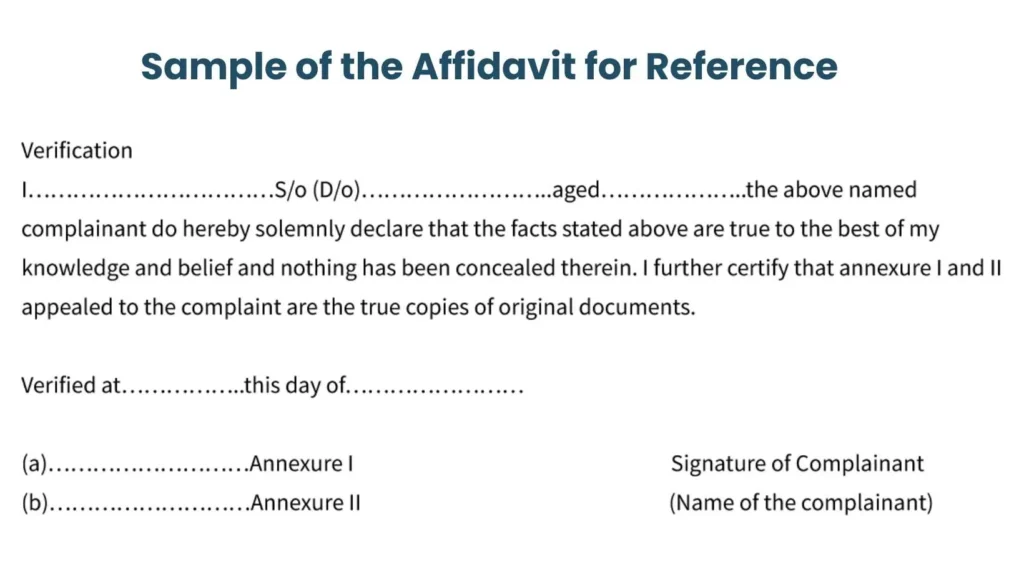
Sample of the Affidavit for Reference
Step-by-Step Guide: How to File a Consumer Court Complaint
It is possible to file a consumer complaint more easily due to the digital tools. Over 650 consumer commissions in India accept online filings in 2026. Approximately 540,000 complaints were registered last year online.
- Write the complaint: The second step is to prepare the complaint: use Form 1-A and write down your details, the details of the other party, the facts the legal points as well as the relief you seek.
- Prepare evidence: Assemble all evidence such as receipts, warrants, emails, photographs, expert opinions and the legal notice with delivery evidence.
- Pay the fee; calculate the fee depending on your claim value, pay online or through the demand draft to the commission and save records of receipt.
- Send to the right forum: File the complaint with the relevant consumer commission any one of the three (district, state, and national) based on the cost of claim and locality.
- File a case: Once you have filed you will be assigned a case number which will be used to track the dates and the status.
Drafting the Complaint
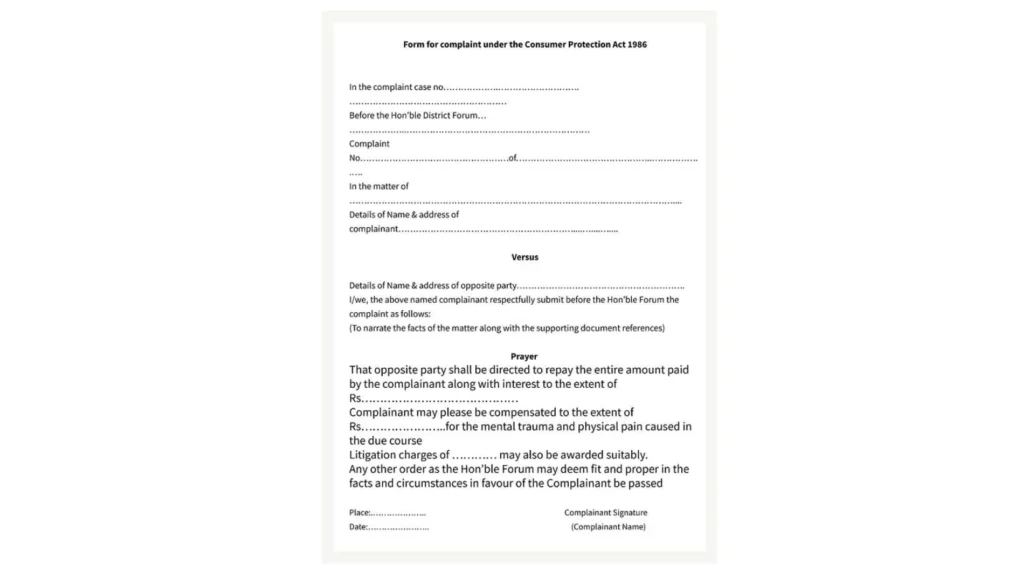
The foundation of your case is based on your complaint. It has to be direct and concise. Write your name, address and phone number, and write those of the other party, use Form 1 -A.
Describe the purchase in sequence: know when and where you purchased the goods or available services, what they promised, how the goods failed or the services were no good and what you did to attempt to rectify the situation. In 2026, the courts desire unambiguous complaints; those that are good are heard at an accelerated rate of 30%. Ask for just the amount of money you desire.
Divide it into components: the price of the product, additional losses, and money in case of any harassment. Include documents, which prove each of the points in a numerical order. The knowledge of how to file a consumer court case consists in knowing how to draft a good complaint as any badly drafted complaint is likely to be objected.
Online Filing (e-Daakhil / e-Jagriti)
Through the portal e-daakhil (edaakhil.nic.in) Or e-Jagriti, people in India have found it simpler to submit consumer complaints over the internet. It was initiated in the Consumer Protection Act 2019 and allows any individual to initiate a case in the comfort of the home or any other location.
The initial step is registering on the portal, in which some basic details and creation of a username and a password are required. Select the consumer commission which encompasses you depending on the place of residence and the value of the claim. Thereafter complete the online complaint form (Form 1-A) with requisite information. Add any supporting materials in PDF format (one file typically can be up to 10Mb).
Considering 22 regional languages it works in 22 languages as of 2026. Submit the filing fee via the payment gateway on the site by using a credit or debit card, net banking or UPI. After having made a complaint to the system, you will receive an email and a text message that contains the case number. On same portal, you can always know the status of your case, get the date of hearings and download any order. The number of people using the system has increased with the majority (45 percent) of complaints being made online.
Offline Filing
When you would rather complain physically, it is also extremely popular, particularly among the older generation or where the internet connectivity is low. Visit office of consumer commission at its regular working hours carrying your complaint form and documents printed.
In order to file offline one should request the commission office to provide the Form 1 A or otherwise through the official site download it and print. Handwrite the form, ensure the handwriting is legible and you do not leave any space without a box. Duplicate the complaint and accompanying documents, five copies in total, retain the originals and affix copies which you swear are true.
At the commission counter pay either in cash or in a demand draft as permitted. Upon submitting the file, the staff will take it and provide you with a stamped copy of the acknowledgment with your case number and a first hearing date which will be tentative. Store this as an evidence that you filed.
How to File a Consumer Court Case Against Specific Entities
Different types of businesses have got varying complaint similarity techniques with e-commerce and banking particularly with specific rules having set rules that even speed up the process of complaint although the success rate differs between 35 to 42 blessing by the sector.
- Online stores: Complain to the market place and the vendor in case you have the contact details of the vendor on the invoice. Refer to the consumer protection regulations in trading online in particular so as to refer to the defective packaging or delivery complications.
- Service providers: Use the opposite side as the service provider company or service provider. Record service contract, enumerate any failures and retain a copy of email or chat message that indicates the issue.
- Banks and NBFCs: Here the other party also includes the bank or the finance company. See RBI instructions, and copy letters by way of copying in case you have previously used Banking Ombudsman. Retain statements of accounts as proof.
- Real -estate developers: Name the developer and the project. Attach the sales agreement, receipts of payments and pictures of anything not the same as promised.
- Insurers: Prosecute an insurer. Nail the policy, premium receipts, rejection letters, and medical records in the loss should these apply to the loss.
Online Purchase (e.g., Flipkart, Amazon, Myntra)
A lot of grievances relate to e-commerce in 2026. Filling an online marketplace, include the marketplace and the seller when possible. Store all order confirmation emails, invoices, product description, site screenshots, delivery notes and communication with customer support. We begin our complaint by the delivery of the product to you.
Things that are very common include, getting the wrong thing, a damaged product, fake product, non-delivery despite having paid, and faulty products in which case there cannot be a return accepted. The marketplace is also found guilty by the courts to take action when it cannot check the seller or maintain the quality standards. Add any feedback of the complaint service of the marketplace and monitor shipping information as evidence. The point is to record all the stages of online transaction.
Against a Bank
Banking issues constitute an approximation of 28 3/4 in 2026. Put a case against the bank, with the particular branch or head office where the issue occurred in the name. Common issues include account opening, hidden fee, incorrect debits, delay in loan processing, declining to open an account, selling products and bad customer service.
Prior to the case going to court, first complain to the grievance cell of the bank and then to the Banking Ombudsman in case you are not satisfied. Replicate Ombudsman reaction since the courts like to observe that all other possibilities have been exhausted. As well as bring account statements, records of transaction, and records of loan agreements and evidences of any financial loss. RBI indicates that banks are required to respond to a consumer court notice within a period of time, not exceeding 30 days.
Banking service is also subjected to the Consumer Protection Act hence a powerful area of the consumer courts. Others have attained compensation of emotional stress and financial devastation as a result of bank trouble.
Fee Structure & Costs
| Claim Value | District Commission Fee | State Commission Fee | National Commission Fee |
| Up to ₹1 lakh | ₹100 | ₹200 | ₹500 |
| ₹1 lakh – ₹5 lakh | ₹200 | ₹400 | ₹2,000 |
| ₹5 lakh – ₹10 lakh | ₹400 | ₹800 | ₹4,000 |
| ₹10 lakh – ₹20 lakh | ₹500 | ₹2,000 | ₹5,000 |
| ₹20 lakh – ₹1 crore | Not applicable | ₹4,000 | ₹7,500 |
| ₹1 crore – ₹10 crore | Not applicable | ₹5,000 | ₹10,000 |
| Above ₹10 crore | Not applicable | Not applicable | ₹15,000 |
Time Limit for Filing a Consumer Complaint
Consumer Protection Act 2019 provides two years as a limit of claim as a complaint. The time of clock starts as soon as you discover an issue – as soon as you purchased a good, contracted a service, discovered a flaw, or realized a shortcoming. Section 5 of the Limitation Act will permit the delays to be overlooked in case you are able to demonstrate a proper cause of delay.
Approximately 15% of complaints are turned off in 2026 due to lateness. In terms of persistent issues, which occur on a regular basis, the period begins with the last time they occurred. In case the matter is a fraud, then the time begins on discovery of the fraud. Then scramble evidence speedily and file within time because the time limit is strictly adhered to in your court and even the case which can be good is dismissed due to late filing of the case.
What Happens After You File
Once you have filed your complaint, it is vetted by the commission to ensure that it is a complete and complete case on the commission. They can either take it or in 21 days inform you what is bad so that you can amend it.
After accepting the complaint, there is a notice given to the other party and the latter has 30-45 days to submit a written response. The commission lectures it, which is a first hearing normally 6090 days following the filing. During the hearing both parties present their cases, interrogate witnesses and argue.
The commission also promotes mediation prior to the case being taken or at the beginning of the hearing in 2026. Approximately one-fifth of the cases are resolved in this manner. In case of a failed mediation, then the case proceeds to evidence recording, cross-examination and conclusion.
The commission can demand goods inspection, form expert committees, demand additional documents. The decision is not finalized and what happens after the last arguments is that the commission orders normally 30-60 days.
Is It Worth Going to Consumer Court?
The order provides you with a copy of the relief granted to you, the compensation, and the timeframe in order to do so. Being familiar with consumer court filing is being prepared to the entire process.
The consumer courts are clearly better than the regular civil courts hence they are suitable in real consumer complaints. District cases are completed between 6-8 months but the civil court cases take 3-5 years.
The filing cost is low between 100 to 15,000, and civil court cost is high. You need not have a lawyer since you may represent yourself thus save money. Most of the complainants succeed and completely win their battle in 2026, 38 percent.
Compensations do not have to be in the form of refunds, but also in the form of mental distress and harassment as awarded by consumer courts. It may at times be 2-3 times the transaction.
It is easy to use and easy to understand as it has a relaxed and consumer-friendly atmosphere. The point of execution is a problem, though: an average of 35 percent of good orders require additional steps to be implemented. With less than 20,000 claims, it may not be worth the time and effort making the claim unless the case is significant. Consumer courts can be justified on larger claims where the evidence has sound basis.
Conclusion
The ability to know how to file a case in consumer court is power to ensure that your rights are respected. The system is tri-tiered or has three levels, namely District, State and National Commissions, hence all categories of claims are heard. The e-Daakhil portal and less complicated processes allow filling in the forms more readily than ever before digital tools. Good documents, time of filing and presentation of facts are essential to win in consumer court.
Consumer courts provide real solutions whether it is a matter of faulty products, bad services or unfair trade. Consumer courts in India are still the most consumer-friendly despite the limitations such as enforcing them, however. In case there is any genuine grievance, visit consumer court. Your rights are meant to be safeguarded and that is the job of these courts to do it inexpensively and expeditiously.
FAQs
Can I file a consumer complaint without a lawyer?
Yes, you don’t need a lawyer. You may sue and defend yourself, but a lawyer is of assistance when the case is big or tangled.
How long does a consumer court case typically take in 2026?
A District courts take between 6-8 months, State Commision between 12-15 months, and the National Commission between 18-24 months. Speed is dependent upon the complexity of the case to be considered and the work load of the commission.
What compensation can I claim in consumer court?
Refund, replacement of items, remedial of flaws, compensation in case of loss or injury, reparations in case of negligence or hustle, and compensation due to mental turmoil or torment.
Is there any fee for filing a consumer complaint?
Yes. Fees begin at 100 in claims of up to 1 lakh and deliver on a fraction of 15,000 in claims of over 10 crore based on the amount paid on commission.
Can I file against international companies or foreign sellers?
Yes when they carry out operations, branches or agents in India or when the transfer concerned occurred in India. Entrepreneurs who are purely foreign may turn out to be more difficult to prosecute.