


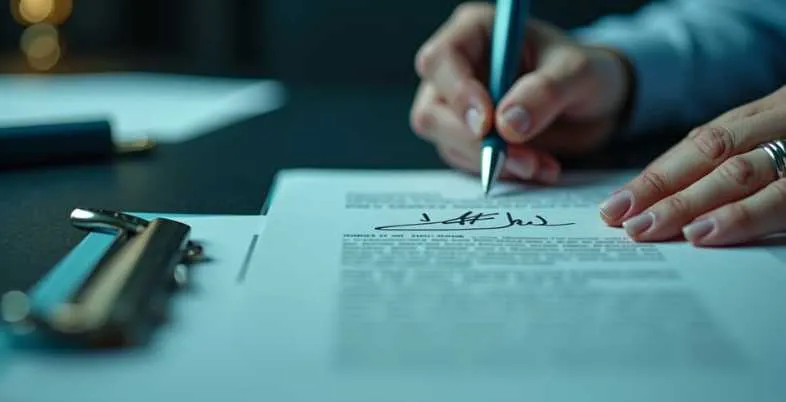
In an ever-changing world that is quickly becoming digital in all aspects, it is somewhat surprising that the handwritten signature has not yet been dethroned. Whether it is a mortgage, a legal contract, or a government document, you have probably been requested to be able to provide a wet signature at one point or another. What is that term anyway and what does it matter anyway?
What is a wet signature is a question that has become more significant than ever as quality businesses and individuals are able to walk the thin line between the days when everyone used paper-based processes and digital workflows that are increasingly becoming attractive to businesses and individuals. This paper will give the whole thing down to size, in an easy, understandable, and utterly comprehensive way, so you can put your signature on it, be it with a pencil or a pixel.
What Is a Wet Signature?
A wet signature is a hand-written signature that is completed by an individual with the use of a pen, marker, or any other writing tool that utilizes ink on a tangible document. The term is based on the concept that the ink actually is wet when signing, before it is dry on paper.
Knowing what is a wet signature is is a way to tell it apart in relation to digital or electronic versions. It is believed to be the most ancient mode of signature, and was employed over centuries in legal, business, and personal commercial dealings. Even today, it is the gold standard of authentication and identity verification in many institutions.
Why Is It Called a “Wet” Signature?
The name can be rather strange, but the explanation is even simpler. Here’s why:
- Ink dries after application: The term wet describes the period between the time the fresh ink is placed on paper and the time it is completely dry to adhere to the surface.
- History: Before ball pens, people would use quill pens with wet ink, so the wetness of the pen was very literal and very apparent.
- Opposition to digital techniques: The name was popularized to differentiate between traditional, ink-based, signing and dry, digital or electronic, signatures where no ink is used whatsoever.
- Tactile and physical: A wet signature is a type of signature that requires physical contact between a pen and paper as opposed to a virtual one.
- Law terms: The term was introduced in law courts and other legal institutions to officially distinguish between handwritten signatures and electronic ones.
- Notarial and bank language: The use of wet signature in official documentation requirements is common among banks and notaries to prevent ambiguity.
When Is a Wet Signature Required?
There are still numerous scenarios where a wet signature is required or highly desirable even in 2026:
- Real estate transactions: Even in many jurisdictions, the law may demand use of original ink signatures on property deeds, mortgage agreements, and title transfers.
- Wills and testaments: Wills and testaments in most countries must be wet-signed to ensure authenticity and to minimize fraud and forgery.
- Court records: Original handwritten signatures are often required to be accepted in court through affidavits, sworn statements, and legal filing.
- Forms of government: In many countries, certain government forms such as visa, passport, and some tax forms must still be signed physically.
- Medical and healthcare records: legal protection Informed consent and some medical directives are normally signed using ink.
- International contracts: There are other international agreements that need wet signatures because of the varying laws on digital signatures across nations.
Is a Wet Signature Legally Binding?
Absolutely — what is a wet signature but the most ancient and surest form of legal commitment? Wet signature has had a long-standing history of legal enforceability in most legal systems worldwide and has proven to be the most enforceable form of signature. Across the board, wet signatures are considered by the courts to be proof of consent and approval.
They are particularly necessary in transactions of significant value because property, financial liability or life choices, including marriage, adoption or writing a will are involved. In law, a wet signature usually involves that the signatory must be of sound mind, voluntary, and signing the proper document. When accompanied with the seal of a notary, or a witness, it is an even more effective legal tool, one which holds its own in any courtroom.
Wet Signature vs Electronic Signature — Key Differences
| Feature | Wet Signature | Electronic Signature |
| Medium | Ink on paper | Digital format on screen |
| Speed | Slower, requires physical presence or mailing | Instant, can be done remotely |
| Cost | Printing, mailing, storage costs | Low cost, paperless |
| Legal Status | Universally accepted | Accepted in most countries (varies by law) |
| Security | Risk of forgery, physical damage | Encryption, audit trails |
| Storage | Physical filing required | Cloud storage, easy retrieval |
| Environmental Impact | Higher (paper usage) | Lower (paperless) |
| Verification | Visual comparison, notarization | Digital certificate, metadata |
Advantages of Wet Signatures
In spite of digital revolution, wet signatures have real and tangible advantages:
- Universal legal acceptance: Wet signatures are accepted and enforceable under virtually all legal jurisdictions on the planet with no exceptions whatsoever.
- No tech needed: Signing with a pen does not need zero software, internet or devices, so that it can be used by all people despite their level of tech literacy.
- Close personal identity association: A handwritten signature is a personal identity that is regarded as an immediate personal expression of identity.
- Favored by traditional organizations: Banks, judicial courts, and government organizations tend to favor or require wet signatures on important documents.
- Wet signature with notarization: A wet signature that is notarized or witnessed is very hard to refute or legally contest.
- Psychological weight: It is more binding when the documents are signed by hand and this makes both parties more serious and serious.
Disadvantages of Wet Signatures
Although it is very powerful, wet signatures do have their downsides:
- Time wasting practice: In person signing, sending the documents through mail and awaiting the return signature can result in long delays in the working processes.
- Expensive operation costs: Printing, courier, physical storage, and document management are costly business operations.
- Environmental impact: The use of paper documents leads to deforestation and increased carbon footprints as opposed to the digital process.
- Loss or damage: There is a risk of loss or damage to physical documents, which may be lost, damaged by water / fire, destroyed – this creates some grave legal issues.
- Lack of remote usability: Wet signatures are not able to be performed remotely real-time, which is one of the significant drawbacks in the current globalized and work-from-home world.
- Hard to authenticate in a hurry: it can be slow and resource-intensive to authenticate a wet signature due to the manual comparison or the need of a notary.
Wet Signature vs Digital Signature vs Electronic Signature
| Feature | Wet Signature | Electronic Signature | Digital Signature |
| Format | Physical ink on paper | Electronic mark or typed name | Cryptographic, certificate-based |
| Technology | None | Basic software or app | PKI encryption technology |
| Security Level | Medium (forgeable) | Medium | Very High |
| Legal Validity | Universally valid | Valid in most jurisdictions | Highest digital legal standing |
| Verification Method | Visual or notary | Timestamp, IP address | Digital certificate authority |
| Use Case | Legal docs, real estate, wills | Business contracts, HR forms | Financial, government, high-security |
| Speed | Slowest | Fast | Fast |
| Cost | Moderate to high | Low | Low to moderate |
Can a Wet Signature Be Scanned or Sent Online?
This is among the most frequently posed questions after people know what is a wet signature – and the context and jurisdiction make the difference. A wet signature scanned and transmitted over the internet is quite acceptable and legally adequate in most business-related scenarios. The scan retains the visual signature of the original ink signature and is considered a valid representation by most business organizations.
Unless it is a minor legal form, like a property deed, a will, or a court affidavit, though, a scanned signature might not be adequate, and the wet-copy must be sent in person, or by certified mail. Certain jurisdictions have enacted laws that a scanned wet signature has the same legal effect as the original, although both parties must concur, and that the type of document being signed allows it. Never assume a scan will do the job of important documents; always confirm with a legal professional.
Are Wet Signatures Still Relevant in 2026?
You may be thinking that the question of what is a wet signature is is no longer relevant at all due to the extent to which digital technology has developed. The truth? Yes, certainly, but maybe more than you and I know. Electronic and digital signatures have replaced vast areas of daily business communication, contracts, and HR processes, but even in 2026, wet signatures will still be the most relevant in a variety of applications.
Original ink signatures are still required in real estate, notarial documents, international agreements, government issued paperwork and judicial filings. In addition, physical signature is more accepted and believed in by many older demographics and regulation agencies. The hybrid workplace has in fact made the use of a clear signature policy all the more common, and it has become all the more crucial to understand what is a wet signature or a digital one is necessary.
Common Mistakes to Avoid
One thing is knowing what a wet signature is and another thing is the correct use of a wet signature. Avoid the following pitfalls:
- Signing an incorrect page or document version: It is a good rule to ensure you sign the final and right version of the document so that disputes do not arise and the contract is not nullified.
- Writing with a pencil: Pencil signatures do not count as legal; all official wet signatures should be done with a permanent ink pen.
- Signing blindly: Never sign an agreement without thoroughly reading it, a wet signature means that you agree and is legally binding.
- Missing witness or notary: There are documents that by law have to have the witness or notary in the presence when signing; otherwise, it will nullify the agreement.
- Unreadable or irregular signatures: Although the law does not demand that a signature be beautiful, inconsistent ones may cast doubt on authenticity.
- Failure to retain a copy: It is important to have a copy of all signed documents that you keep personally; when you lose your copy, you are providing an easy mark to opposing counsel.
Conclusion
Since the earliest quill-and-ink contracts to modern sophisticated property transactions, what is a wet signature has been one of the most basic questions in law, business, and daily life. With the combustive rise of digital substitutes, the ink signature written down by hand has not disappeared yet — and it is unlikely that it will any time soon.
Knowing when, why, and how to use a wet signature equips you with the knowledge to operate in legal and business environments with certainty. Whether you are closing a real-estate transaction, signing a will or just filling out a governmental form, when you know the force behind that pen, you are guaranteed to always be on the right side of the law. Be smart, be purposeful.
Explore More About:
FAQs
What is a wet signature and why is it important?
Wet signature refers to an ink signature on a paper document that was written by hand. It is legally important, in that it constitutes personal intent, personal consent, and personal identity, and is understood to be binding in all but one legal system in the world.
Does a scanned wet signature have a legal basis?
Yes in quite a lot of business situations. But in some cases, such as wills, property deeds or even court filings, the original hard copy with wet signatures may be needed.
What is the distinction between a wet signature and a digital signature?
Wet signature involves ink on paper, whereas digital signature involves cryptography technology to check the identity electronically. Digital signatures are more secure due to encryption methods and are not universal across all locations yet.
Is it possible to use an electronic signature in lieu of a wet signature?
In many cases, yes. Nevertheless, there are still documents that cannot be signed with a wet signature in ink, particularly those that feature real estate, notarization or court proceedings.
Will there be a wet signature in 2026?
Yes, absolutely. Digital and electronic signatures have become widely accepted but even by 2026, wet signatures continue to be required on many legal, governmental and high-stakes financial documents.